
The 50mm: My Way of Seeing
I have always had a particular affection for 50mm lenses, especially the classic f/1.4 designs. For me, a 50mm is more than just a focal length. It is the perspective I naturally gravitate towards when photographing people, allowing me to get close enough to create an intimate portrait while still leaving room for a little storytelling.
Much of my photography is inspired by the glamour of Old Hollywood, and I am drawn to lenses that bring something of that same atmosphere to an image. I don't necessarily look for clinical sharpness or perfect optical correction. I want beautiful skin tones, a gentle transition from focus into the background and that particular rendering that gives a photograph its own character. A lens should be more than a tool for recording what is in front of the camera.
For me, it is part of the creative process, and the classic 50mm f/1.4 has always felt like home.
My Cabinet of 50mm Lenses
I have a cabinet full of 50mm lenses. They are my paintbrushes, and by now I know them well. I know how each one renders a face, how it frames a scene and which one I reach for when I have a particular look in mind.
The Summilux has always occupied a special place in the Leica M lineup for me, sitting between the Summicron and the Noctilux.
Fast, full of character, yet compact enough to carry all day, it is a combination I keep returning to.
Some of my favourite photographs have been made with a 50mm, and I keep coming back to the focal length for that reason.
A Long History with the Summilux-M 50mm f/1.4
The Mandler 50mm f/1.4 E46 Pre-A in brass, photographed in warm, cinematic light.
The classic finish and vintage-inspired character of this fast Leica M lens fit naturally into my approach to portrait photography.
I have owned and used most versions of the Leica Summilux-M 50mm f/1.4. Having spent so much time with these lenses, I have come to appreciate how differently they can render an image. Small differences in softness, contrast and the transition into the background can change the character of a portrait. They may share the same focal length and maximum aperture, but to me, they are not simply different versions of the same lens. Each has its own personality.
There is also something special about the way these lenses age. A black paint Summilux in near-mint condition can almost be too beautiful to handle, a piece of photographic history you hesitate to take out of the cabinet. Yet I find an equally strong attraction in one that has been used for years, with the brass showing through the paint and a beautiful patina telling the story of its previous owners. These lenses seem to become more personal with time.
I once owned a black paint Summilux-M 50mm f/1.4 Pre-ASPH that I eventually let go, and it is one of those lenses I still miss. Beyond its finish, I loved the way it rendered a photograph. Wide open, it had a particular softness and gentle glow, with natural colours and a beautiful transition from the subject into the background. That rendering has stayed with me, and it continues to shape what I look for in a 50mm lens.
So when I came across the Mandler 50mm f/1.4 E46 Pre-A, I was curious. Could a modern interpretation of that classic optical approach deliver some of the qualities I loved in the Summilux, while bringing something of its own to the Leica M system?
Enter the Mandler 50mm f/1.4 E46 Pre-A
I had already explored Mandler's approach to classic optical character in my review of the Mandler 35mm f/2. I was curious to see how that philosophy would translate to a 50mm f/1.4, a focal length I know particularly well and use often for portraiture. With the classic Summilux as a point of reference, I wanted to find out how closely the Mandler approached that familiar rendering, and whether it would earn a place among the many 50mm lenses I already know and use.
When I asked Mandler about the development process, the team explained that one of the main lessons from the 35mm f/2 project was that photographers want a distinctive rendering without sacrificing too much edge sharpness. Several directions were explored for the 50mm f/1.4. According to the team, some versions were even sharper than an ASPH lens, but lacked the character of the original. Others felt too modern, while some came too close to the old E46.
The final version was an attempt to find the middle ground: preserving the atmosphere of a classic Pre-ASPH lens while improving central sharpness, edge performance and close-focusing usability. Mandler also told me that feedback from photographers influenced the optical priorities, not just the mechanical design.
Design and Build Quality: The Beauty of Brass
For this review, I chose the chrome-plated brass version of the Mandler 50mm f/1.4 E46 Pre-A. There was never much doubt about that. I have a particular affection for brass lenses, especially those with a beautiful finish that feels just as good in the hand as it looks on the camera. The Mandler has a lovely colour and finish, and the construction feels sturdy and reassuring. It is a lens that feels properly made, with a satisfying weight that suits the experience of shooting with a Leica M. I also have the matching brass lens cap, which completes the package beautifully.
The brass version weighs 385 grams, compared with 290 grams for the black anodised aluminium version. Both share the same optical design, so the choice comes down to weight, finish and personal preference. For me, the extra weight is part of the appeal. The lens feels substantial without becoming unwieldy, and its classic appearance fits naturally alongside my Leica M cameras and other vintage-inspired lenses.
The brass Mandler 50mm f/1.4 E46 Pre-A mounted on my Leica M11-D, paired with a red leather camera case by Angelo Pelle. A classic-looking combination that feels right at home in my collection of Leica M lenses and vintage-inspired photographic equipment.
The details are well considered, too. The focusing ring has smooth, consistent damping and a relatively short throw, while the aperture ring offers clear clicks and supports half-stop adjustments. The lens uses a 46mm filter thread, has twelve aperture blades and measures just 46.5mm in length. It is a compact design considering its maximum aperture of f/1.4. Mandler lists the optical construction as seven elements in five groups, with an aperture range from f/1.4 to f/16.
One detail I have mixed feelings about is the built-in, retractable lens hood. I understand why Mandler retained this design. It stays true to the classic Summilux look and means you do not have to carry a separate hood. However, for my own work, I would prefer a more ventilated, screw-in lens hood that attaches to the filter thread. It would give the lens a slightly different look, but I think it would suit my way of working better. I may look into adding one later, provided I can find a version that fits properly without compromising the handling or appearance of the lens.
Overall, the Mandler makes a very good first impression. The brass finish, the solid feel and the traditional controls all contribute to a lens that feels at home on a Leica M. But beautiful construction is only part of the story. What matters most to me is what happens when I look through the viewfinder and start making photographs.
Close Focusing: Beyond the Rangefinder Limit
The Mandler 50mm f/1.4 E46 Pre-A on the Leica M11-D. The close-up reveals the lens's engraved aperture and focusing scales, a reminder that its appeal lies not only in its rendering but also in the tactile experience of working with a manual-focus lens.
One small detail I would have liked to see is a clear indication on the lens that you are focusing below 0.7 metres. The Mandler can focus as close as 0.5 metres, but the rangefinder coupling only works down to 0.7 metres.
On the Leica M11 series, I often switch between the rangefinder, an external EVF and the rear screen during a shoot, depending on the subject and composition. When working close to a portrait, that extra focusing range can be genuinely useful, but you need to be aware of when you have moved beyond the rangefinder's limits.
A small tactile marker at the 70cm position would make that transition more intuitive, particularly for photographers who prefer to work through the optical rangefinder.
I raised this with Mandler, and the team confirmed that it had evaluated the idea but left it out of the current version to preserve the consistency of the exterior design.
They will keep the suggestion in mind for future models. It is not a major flaw, but I still think it would be a thoughtful improvement for photographers who regularly use the close-focusing capability.
Optical Design: Classic Character, Modern Refinements
The Mandler 50mm f/1.4 E46 Pre-A is built around a seven-element, five-group Double Gauss optical design. It follows the traditional all-spherical, Pre-ASPH approach, without aspherical elements, with the aim of preserving the distinctive rendering associated with classic fast 50mm lenses.
According to Mandler, the optical formula largely follows the original E46 design, with the main changes found in the glass selection, coatings and aberration tuning. High-refractive-index glass helps control spherical aberration and field curvature at f/1.4, while low-dispersion glass is used to reduce longitudinal chromatic aberration and the purple or colour fringing that can appear along high-contrast edges.
Mandler also claims a 20–25% improvement in resolution compared with the original design. These are the manufacturer's explanations and figures, but the intention is clear: to improve sharpness and usability without abandoning the character of a classic Summilux.
One of the things I find interesting about this approach is that sharpness is not the only goal. A lens can resolve plenty of detail and still produce images that feel flat or clinical. What I look for, particularly when photographing people, is the way a subject separates from the background, how the focus transitions into the out-of-focus areas and whether the rendering gives the portrait a sense of depth. Mandler specifically highlights this three-dimensional quality and the subtle, swirling character of its bokeh. Those are qualities I wanted to explore in my own photographs rather than simply take at face value.
Portrait Rendering: A Beautiful Balance
Bettie from Hell, photographed with the Mandler 50mm f/1.4 E46 Pre-A wide open. Warm light, deep shadows and the delicate transition between sharpness and blur give this intimate portrait its cinematic, vintage-inspired character.
This is where the Mandler 50mm f/1.4 E46 Pre-A started to win me over. Looking through the portraits I made with it, I was struck by how naturally it handled faces. The vintage character is there, but it does not dominate the photograph.
I particularly love the way it renders skin. The colours are gentle and natural, with a softness that I find very flattering. When you focus on the eyes, the skin takes on this smooth, almost delicate quality, without the image losing its sense of detail. There is a slight glow around the areas in focus, especially wide open, which gives portraits a certain atmosphere. It is not the kind of softness that simply makes everything look out of focus. Instead, there is still enough definition where it matters, allowing the face to remain the centre of attention.
The transition from the subject to the background is equally pleasing. At f/1.4, the background melts away, creating separation without making the image feel artificial. According to Mandler, the balance of spherical aberration plays an important role in this rendering, alongside factors such as the aperture blades, field curvature and vignetting. The company also says it has reduced the pronounced cat's-eye bokeh found in some older E46 lenses, producing cleaner out-of-focus highlights while retaining their shape and a natural fall-off into the background. In my photographs, the result has a distinctly classic feel without the background competing with the subject.
What I find particularly interesting is how the vintage character becomes more pronounced as I move closer to my subject. At a more comfortable portrait distance, the rendering feels relatively restrained, but when I move in, the character of the lens becomes much more apparent. The effect is not about an exaggerated, floating look. Instead, the rendering feels more direct and intimate, with the lens's particular combination of softness, glow and focus transition becoming easier to recognise. I noticed this while photographing Bettie, especially in the closer portraits, where the lens seems to reveal more of its personality.
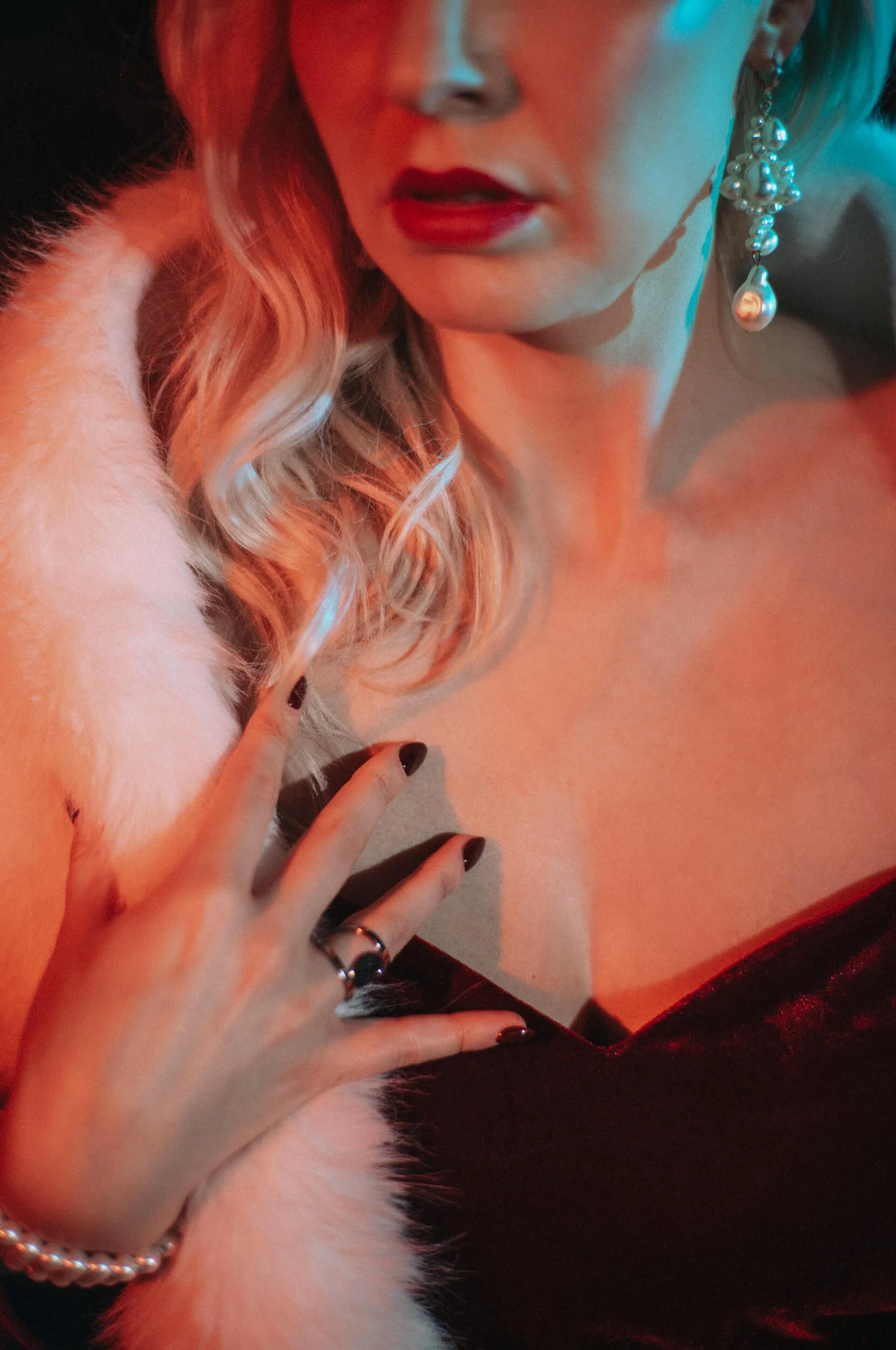
One detail I particularly like in the closer portraits is the way tiny reflections around the eyes catch the light. In some of the images, they appear almost like little jewels, with hints of green, amber, red and blue against the darker lashes and iris. The makeup and carefully controlled lighting are an important part of this, but I love how these small reflections become part of the image rather than simply disappearing into the shadows. It is a subtle detail, yet it adds something special to the close portraits.
What matters to me is that the rendering never feels forced. I can use the Mandler for a vintage-inspired portrait without making the effect the subject of the photograph. That is a distinction I value.
Little Shop of Curiosities: Photographing Bettie from Hell
For this shoot, I wanted to create something a little different. The concept was called Little Shop of Curiosities, a mysterious little world built around Bettie's home and the objects she has collected.
Stuffed animals, an unusual swan, decorative pieces and all the small details became part of the storytelling rather than simply serving as a backdrop. I imagined three different scenes: an intimate bedroom setting, a playful and slightly surreal encounter with the swan, and a glamorous evening scene, almost as if we had stepped into a film.
I rarely shoot horizontal, but for a photography review, I like to break up the portraits with a wider frame. And I must say, the Mandler 50mm f/1.4 E46 Pre-A delivered. Even with Bettie stretched out across the bed, I never felt the need for a wider angle. The 50mm captured the scene, the atmosphere and the little details in the room, while the coloured lighting gave the image that cinematic, almost film-still quality I was looking for.
The First Frames: Setting the Mood.
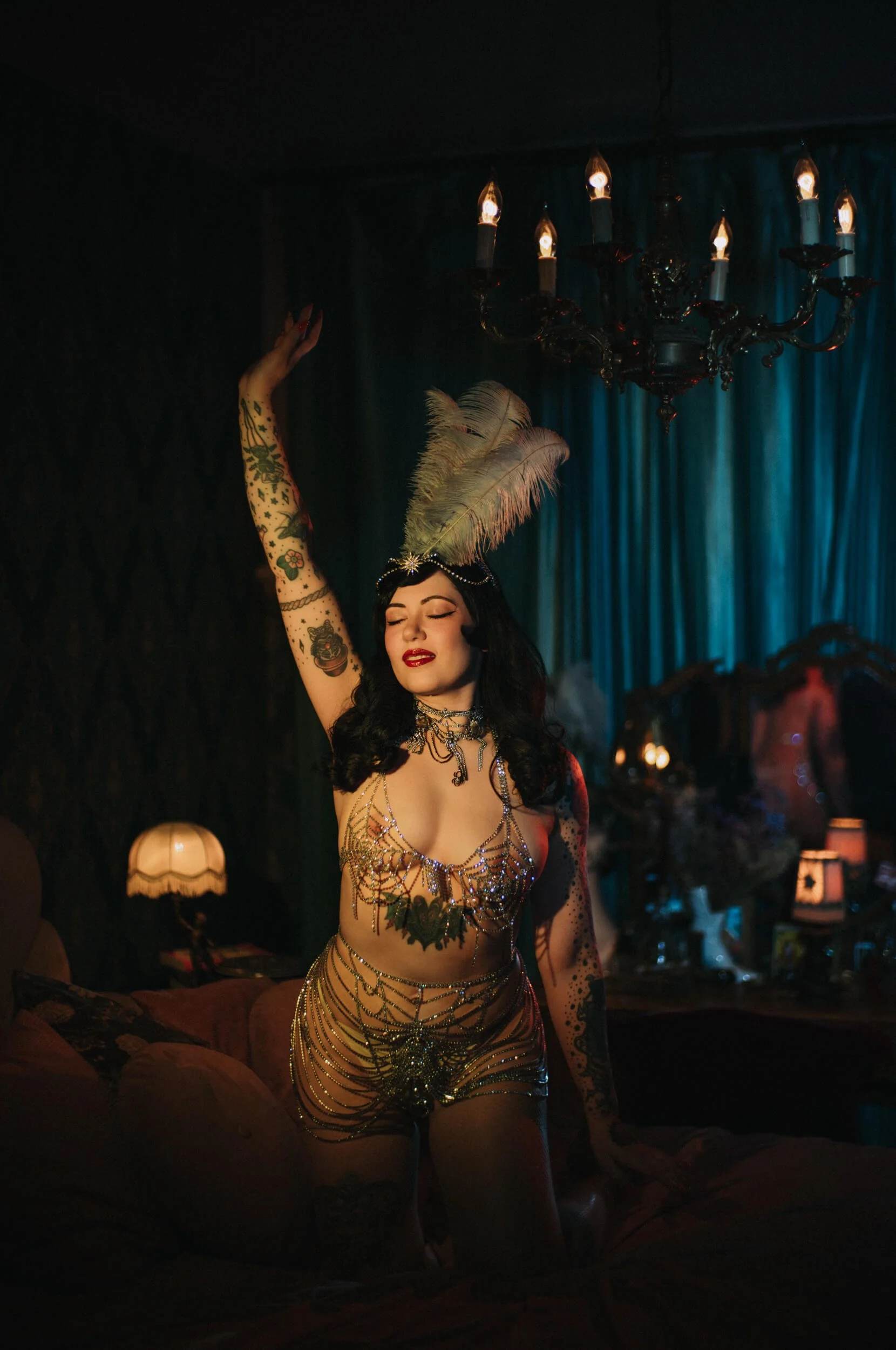
Bettie from Hell in the first setup of our shoot, photographed with the Mandler 50mm f/1.4 E46 Pre-A wide open. I wanted the warm light on her face to contrast with the cool teal curtains and the darkness around her, creating the feeling of a still from a film. The 50mm gave me enough room to include the surroundings while keeping Bettie at the centre of the story.
Every shoot starts with a little uncertainty, especially when I work with someone for the first time. I may have done this a million times, but there is always that excitement before the first photographs are taken. You have an idea in your head, a certain atmosphere you want to create, but you never quite know how it will translate once the model is in front of your camera. Those first few frames matter. They help me understand how the light behaves, whether the lens gives me the rendering I had imagined, and, just as importantly, they help the model see how I envision her. As a photographer and director, I want the person in front of my camera to feel comfortable, to trust the process and, ultimately, to feel beautiful.
For this first setup with Bettie, I wanted something intimate, dark and a little mysterious, almost like a still taken from a film. We closed the curtains because we were shooting during the day, giving me complete control over the light. I asked her to settle on the bed and switch on the bedside lamp, while I used colour gels to introduce subtle tones into the scene and create more depth in the background. I wanted the light to feel motivated by the room itself, with warm practical light contrasting against the cooler tones behind her. From the very first test shot, something clicked. The light, the colours, the scene and the Mandler 50mm f/1.4, shot wide open, came together in a way that already felt close to what I had imagined. There was something slightly edgy and almost art-house about the result, a cinematic mood that relied more on atmosphere and suggestion than on revealing too much.
I transferred a few photographs to my phone through Leica FOTOS to show Bettie the first previews. Seeing how the images were taking shape helped her relax, and I felt that initial tension disappear too. That moment is important to me. The photographs may begin with my vision, but the experience belongs to both of us, and I want the model to feel that we are creating something together. Once we had that confidence, we could explore the idea more freely.
Although some of the images might be a little too daring for Instagram, the intention was never simply to show skin. I wanted the shadows, the warm bedside light, the coloured accents and the surrounding darkness to create a sense of mystery. I wanted each frame to feel as though it belonged to a larger story, leaving the viewer to imagine what had happened just before the shutter was released, or what might happen next. The 50mm felt perfectly suited to the setting. I never found myself wishing for a wider lens, even when photographing Bettie on the bed. I tend to work in portrait orientation anyway, although I also made a few horizontal frames, partly to have a banner image for the blog. We both liked those too.
This is what I enjoy about these personal projects. I usually have a clear idea of how I want the photographs to look before the shoot begins, but the first priority is always to make the person in front of my camera feel good about the result. When that happens and the images also meet, or even surpass, my expectations, I know we are on the right track. With these first photographs, the atmosphere was already there. We had found our starting point, and I could look forward to seeing where the rest of the shoot would take us.
The Swan: A Cinematic Portrait in the Dark
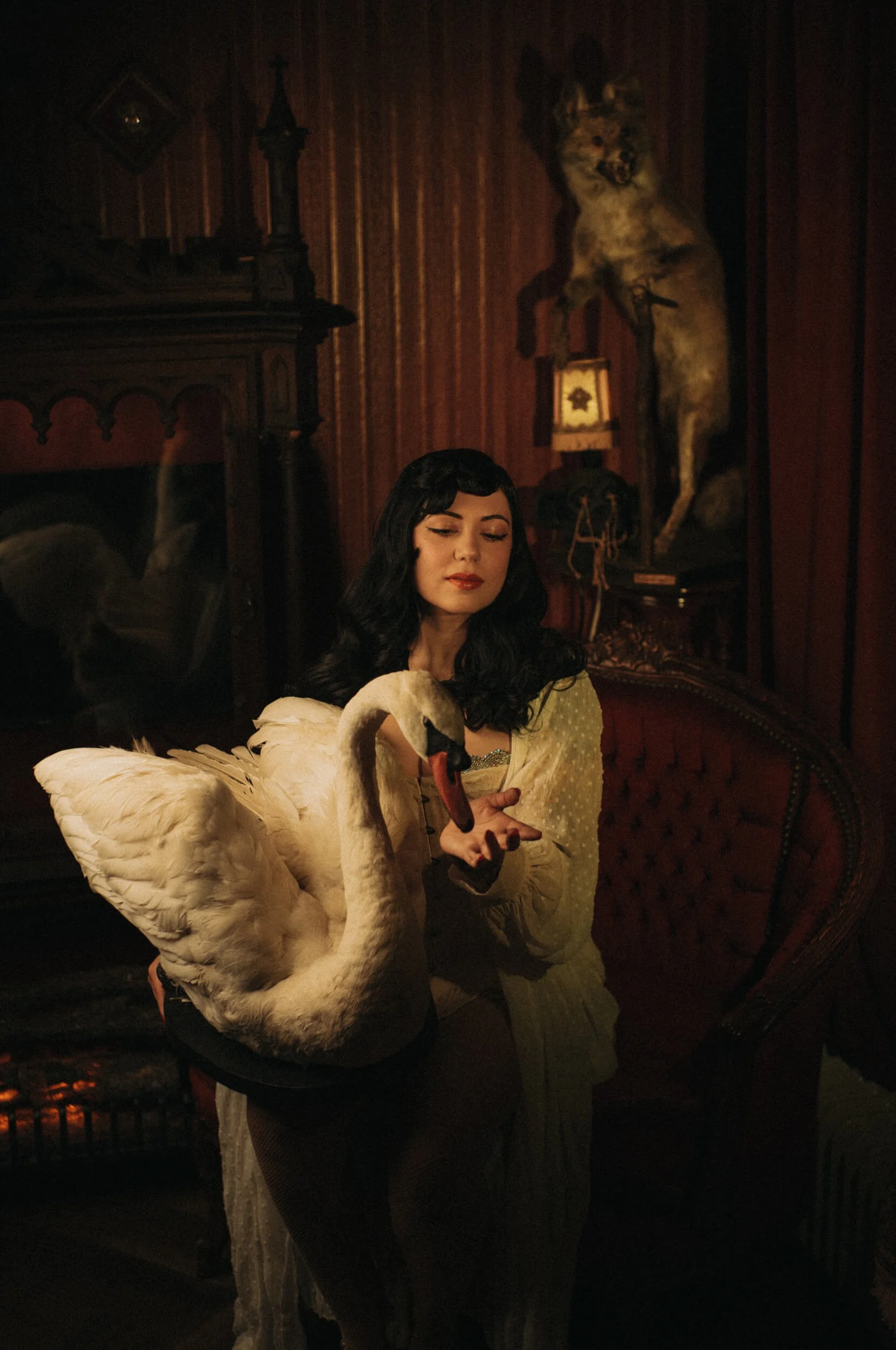
Bettie from Hell has a gorgeous swan in her Little Shop of Curiosities. There is a lovely vintage corner in the room, complete with a canapé, a fireplace and even an angry fox. For this particular series, however, I wanted something darker and moodier. The swan was going to be more than a prop. I wanted it to become part of the story, almost another character in the photograph.
The Swan. Bettie from Hell with a white swan prop, photographed with the Mandler 50mm f/1.4 E46 Pre-A. I wanted the swan to become part of the composition rather than simply a prop, its curved neck partially obscuring her face and adding a little mystery to the portrait. This is also where the lens's close-focusing capability came in handy, allowing me to move closer and keep the relationship between Bettie and the swan at the heart of the frame. The warm light and soft rendering helped create the cinematic, almost dreamlike atmosphere I had envisioned.
The setup was relatively simple. I closed the curtains beside the window to remove the daylight and take control of the atmosphere. On Bettie's left, I placed a Harlowe Pro 300W with an octagonal softbox as the main light. On the right, I used a smaller Harlowe 120W Spectra to add a little fill and balance the shadows. This gave me the contrast I wanted while allowing the colours and textures to remain part of the scene.
Because the swan was also one of the stars of the photograph, I stopped the Mandler down a little. If I remember correctly, I was shooting at f/2.8. I wanted enough definition to bring both Bettie and the swan into the story, rather than letting the background separation become the main attraction. One small caveat with this photograph is that Leica M lenses do not electronically communicate the selected aperture to the camera. The f/2.8 setting is therefore my recollection of how I shot the image, rather than a value I can confirm from the metadata.
For this portrait, I wanted the swan and Bettie to feel part of the same story, almost like a still from an old film. The Mandler 50mm f/1.4 E46 Pre-A captures the warm atmosphere of the room while keeping the scene intimate and natural.
This is also where the Mandler surprised me. Wide open, it has that lovely vintage character, with a gentle glow, a little softness and some optical imperfections that contribute to its personality. Stop it down, however, and the lens becomes noticeably sharper and more contrasty while retaining a touch of that classic allure. The result is a rendering that feels different without losing the character that attracted me to the lens in the first place.
You can see the effect of the lighting in the catchlights in Bettie's eyes. The reflection of the octagonal softbox creates a distinct shape, giving the eyes a little sparkle and reminding you that the light is part of the photograph's construction. For me, that interplay between the lens, the lighting and the subject is what makes portrait photography so rewarding. The lens provides the rendering, but it is how you use it that gives the image its atmosphere.
The Mandler's closer focusing capability also gave me more freedom to move in for tighter compositions. In this frame, I wanted the swan's beak to cover one of Bettie's eyes, creating a little mystery while keeping the image elegant rather than simply unusual. It turned into one of my favourite ideas from the series: a portrait in which the subject and the object share the spotlight, and where a small compositional decision changes the entire mood.
I photographed the series with the Leica M11-D and the Mandler 50mm f/1.4 E46 Pre-A. Across the different scenes, I worked with three Harlowe lights, combining shaped key light, coloured accents and the practical lamps already in the room. Each setup called for a slightly different approach, but the aim remained the same: to create a cinematic atmosphere in which the lighting and the lens rendering worked together.
I particularly enjoy using the existing environment this way. The chandelier, table lamps and teal curtains all become part of the composition. The warm highlights in the background contrast with the cooler tones around the room, creating a cinematic atmosphere without making the photograph feel overly staged. I want the viewer to notice Bettie first, but then gradually discover the little details around her.
The aim was never simply to create a beautiful portrait. I wanted to build a small cinematic world around Bettie, where the lighting, colours, objects and lens rendering all contribute to the same story. The final series brings these elements together, with each photograph revealing another little corner of her Little Shop of Curiosities.
An Evening at the Cinema: Cinematic Portraits in Antwerp
Laura at Cinema Klappei in Antwerp, photographed with the Mandler 50mm f/1.4 E46 Pre-A on the Leica M11-D. I rarely shoot vertically with this much space around the subject, but here the rows of cinema seats help tell the story. The red and cyan colour gels create the atmosphere of a film still, while the 50mm gives me the framing I wanted without needing to reach for a wider lens.
I also took the Mandler 50mm f/1.4 to Klappei, a small arthouse cinema in my hometown of Antwerp. Laura, who follows and admires my work, reached out to me on Instagram with the idea of creating something inside an old cinema. As a film lover myself, with a soft spot for both vintage cinema and arthouse films, it was an idea I immediately connected with. I wanted to capture that nostalgic atmosphere, using just a few props and letting the red velvet cinema seats do much of the storytelling.
For this shoot, I returned to one of my favourite lighting setups: three Harlowe LED lights, the 300W, 120W and 80W. I used the 300W with barn doors to shape the main light, while the two smaller lights were fitted with colour gels. No diffusers. I like working with harder, more direct light when the concept calls for it, especially when I want the colours and shadows to become part of the story rather than simply illuminate the subject.
I also like to change the lighting as a shoot develops. A small adjustment can completely alter the mood of an image, even when the location and subject remain the same. At times, the 300W served as the main light. For other frames, I moved it behind Laura and controlled the beam to create the impression of light emerging from the cinema itself. That shift gave the photographs a different atmosphere, as if the room and its old seats were part of a scene from a film.
The Mandler handled these conditions very well. One thing I particularly appreciated was how well it resisted flare during this shoot. I rarely use a lens hood, and I did not use one here either, despite working with strong backlighting. The lens retained its contrast without unwanted flare taking over the image. Compared with my experience using lenses such as the Steel Rim 35mm f/1.4, Noctilux-M 50mm f/1 and Summaron 28mm f/5.6 LTM, I found the Mandler more forgiving in these conditions. Of course, flare depends on the position and intensity of the light, but this was an encouraging result in a setting where I wanted to preserve the deep shadows and saturated colours.
The Mandler in Practice
Sharpness, Chromatic Aberration and the Beauty of Imperfection
A lens can have beautiful rendering and still come with a few optical compromises. With the Mandler 50mm f/1.4, I find the balance between these qualities more interesting than any resolution chart could tell me. The central sharpness is more than adequate for portraiture, particularly when the eyes are in focus, while the gentle softness around the subject contributes to the overall look I enjoy.
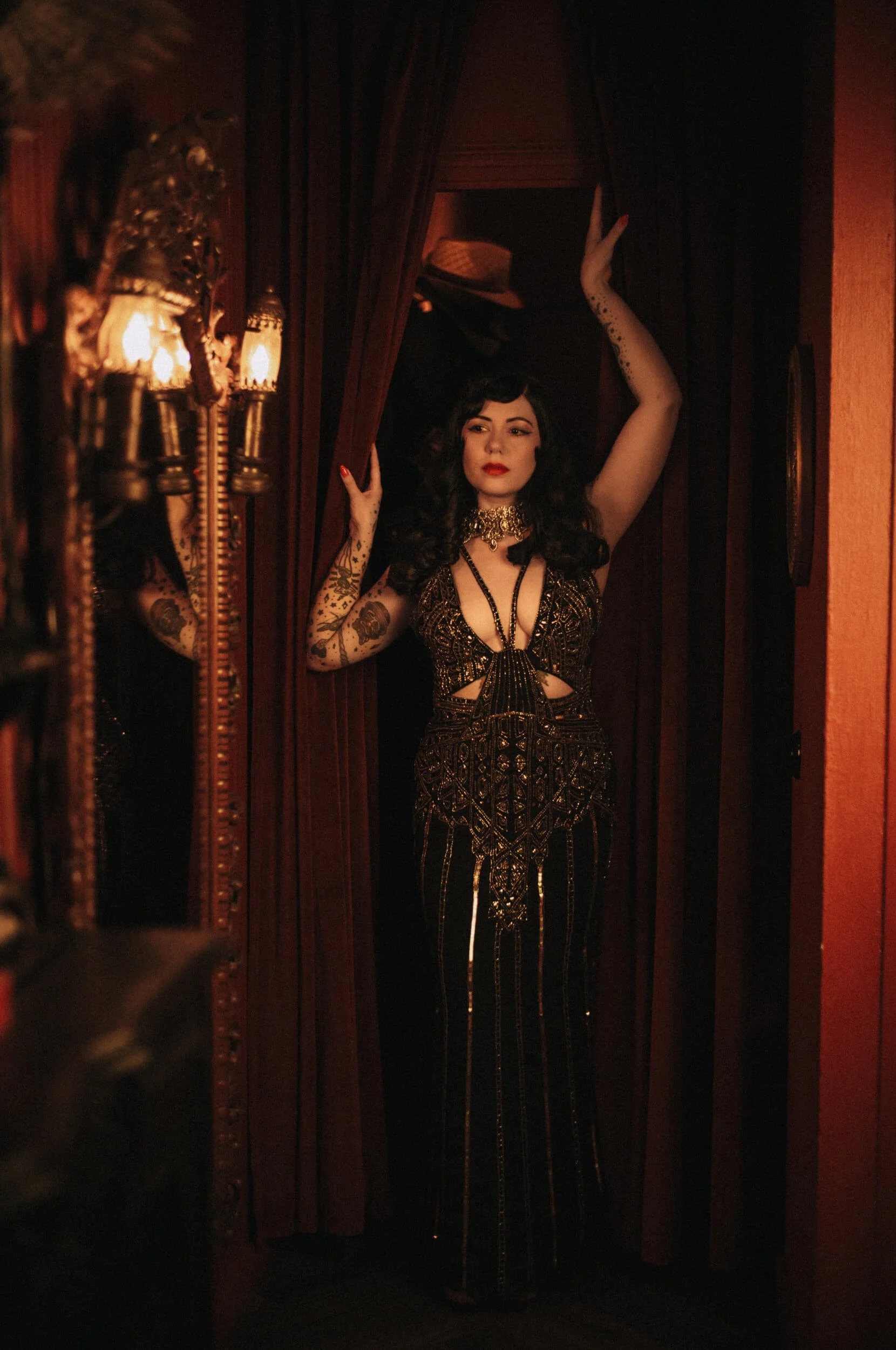
Bettie from Hell, photographed with the Mandler 50mm f/1.4 E46 Pre-A. The warm light brings out the gold jewellery and rich tones of the scene, while the shallow depth of field separates her reflection from the foreground.
What I particularly appreciate is how the rendering changes when I stop the lens down. Around f/2 to f/2.8, the bokeh becomes more controlled, but it is still very much present. The image gains contrast and definition, and the corners sharpen up a little too, without losing all of that vintage character. For me, this is a lovely compromise between the softer, more atmospheric rendering at f/1.4 and a sharper, more defined image when the situation calls for it. I am not someone who spends hours pixel-peeping every corner of a photograph. I care more about the character of the image and how the lens helps me tell a story. In that respect, the Mandler strikes a balance that works very well for the way I photograph.
Wide open at f/1.4, the lens also shows a slight glow around high-contrast details. I find it particularly appealing in portraits, where it softens the transition around certain highlights without making the entire image look out of focus. It is part of the Pre-ASPH character I enjoy, although its visibility naturally depends on the subject, lighting and distance.
One thing I did notice in my photographs was purple fringing around some reflective details, particularly the pearls and other shiny elements. This is worth mentioning because these small highlights can be quite prominent in carefully lit portraits. It doesn't spoil the images for me, but it is something to be aware of, especially when working with jewellery, sequins or other reflective materials against darker backgrounds.
Mandler tells me that the aim was to retain the glow, smooth focus transitions and atmospheric loss of contrast that photographers associate with classic Pre-ASPH lenses, while improving edge performance and longitudinal chromatic aberration. The company has not tried to eliminate every imperfection. Purple fringing and flare can still appear in difficult lighting, as I also found with reflective details in my portraits. For me, the important distinction is between an imperfection that contributes to the photograph and one that distracts from it.
Mandler 50mm f/1.4 vs Leica Summilux-M 50mm f/1.4 Pre-ASPH E46
A detail from the Bettie from Hell bedroom set, photographed with the Mandler 50mm f/1.4 E46 Pre-A. The lamp is the point of focus, with its delicate shade and warm glow rendered clearly, while the pearls on the mannequin fall gently out of focus. I like this kind of scene when comparing the Mandler with the Leica Summilux-M 50mm f/1.4 Pre-ASPH. It lets me look beyond sharpness alone and consider how each lens handles focus, detail and the transition into blur in a real, low-light setting.
Having used most versions of the Leica Summilux-M 50mm f/1.4 over the years, I came to the Mandler with a fairly clear idea of what I was looking for. The original Pre-ASPH E46 has a rendering I have always loved, particularly for portraits. So, does the Mandler manage to capture that same character? In my experience, very much so. The resemblance is striking, from the gentle rendering of skin to the way the background falls away. Looking at my images, I find the Mandler a little sharper in the centre, while retaining much of the softness and atmosphere that make the original Summilux so appealing.
The Mandler also brings a few practical advantages. Its minimum focusing distance of 50cm gives me more freedom when working with tighter portraits and smaller details, whereas the Leica Summilux E46 focuses down to 70cm. When shooting with my Leica M11 series, where I regularly switch between the rangefinder, EVF and rear screen, that extra range is genuinely useful. It is a thoughtful improvement for photographers who want to get closer to their subjects without changing lenses.
However, I would never dismiss the original Leica in favour of the Mandler simply because one lens may be a little sharper or more versatile. The Summilux carries a history that the Mandler, however good, cannot replicate. For me, the Leica name, the heritage of the lens and its place in the history of the M system all contribute to its appeal. Certain versions, particularly those with beautiful finishes and well-preserved examples, also have a collectible quality. Depending on the version and condition, they can retain considerable value on the second-hand market. Owning a classic Leica is about more than the photographs it produces. It is also about the object itself, its craftsmanship, its history and the pleasure of keeping a piece of that legacy in your collection.
There is one practical consideration when buying a vintage example: condition. I have encountered several original Summilux lenses showing haze, so I would always recommend checking the optics carefully before purchasing. This is not to suggest that every copy suffers from the problem, but the condition of an individual lens matters, especially when you are investing in a collectible piece of equipment.
The Mandler comes remarkably close to the rendering I remember from the original Summilux, while offering closer focusing and, in my photographs, a little more central sharpness. The Leica remains the lens with the history and the versions I still find myself missing. For someone choosing between a vintage original and a new lens, those are two quite different reasons to buy.
Who Is the Mandler 50mm f/1.4 E46 Pre-A for?
I would recommend the Mandler 50mm f/1.4 to Leica M photographers who appreciate character as much as sharpness, particularly those who photograph people and enjoy working with available or carefully shaped light. Its rendering has a vintage quality without becoming a gimmick, and stopping down gives you more definition when the subject or composition calls for it. The closer focusing distance is another practical advantage, especially for tighter portraits and details.
If you are looking for perfectly uniform sharpness across the frame or the most clinically corrected image possible, this may not be the lens for you. But if you want a fast 50mm with natural skin rendering, a gentle transition into the background and a personality that changes with your aperture and subject distance, the Mandler deserves serious consideration. It is not simply about recreating the past. It is about bringing some of that classic character into the photographs you make today.
Final Verdict: A Modern Lens with a Classic Soul
Bettie from Hell in The Swan, photographed with the Mandler 50mm f/1.4 E46 Pre-A. The warm, subdued lighting, delicate skin tones and gentle separation from the dark background give the portrait the atmosphere of a still from an old film. I wanted the swan to feel like part of the story rather than simply a prop, with the 50mm allowing me to bring the two subjects together in a single frame. It is a fitting image to end this review, showing the kind of cinematic portraiture for which I enjoy using a fast 50mm lens.
The Mandler 50mm f/1.4 E46 Pre-A has left me with a very positive impression. Having used so many versions of the Summilux over the years, I approached this lens with fairly specific expectations. It has come closer to the rendering I remember from my old black paint Pre-ASPH than I expected, while offering the convenience of a new lens and a closer focusing distance.
The original Summilux will always have a special place in my mind. Its history, the Leica name, the craftsmanship and the collectibility are all part of its appeal. A beautiful vintage example remains something special to own. But I don't think that should lead us to overlook what Mandler has achieved here. This is not merely an imitation of a classic lens. It is a thoughtful interpretation that preserves much of the character I love while adding useful refinements for contemporary photography.
Is it perfect? No lens is, and the purple fringing I noticed around some reflective details is worth keeping in mind. But I don't see this as a lens that needs to be perfect on paper to be valuable in practice. Its appeal lies in the way it renders a person, the atmosphere it brings to an image and the creative possibilities it offers.
For photographers who love the character of classic fast 50mm lenses, particularly for portraiture, the Mandler 50mm f/1.4 E46 Pre-A is worth considering. It gives me much of what I loved about the old Summilux, with the convenience of a new lens and a closer focusing distance. It is not a perfect lens, nor does it need to be. After using it for these shoots, I can see a place for it alongside the other 50mm lenses in my cabinet.
Interested in the Mandler 50mm f/1.4 E46 Pre-A?
If this review has sparked your curiosity about the Mandler 50mm f/1.4 E46 Pre-A, you can find the lens through my affiliate link.
Using my link helps support future reviews, photographic projects and the continued creation of independent content on this website, at no additional cost to you.
Thank you for your support.
Acknowledgements
A special thank you to Bettie from Hell and Laura for being part of these creative shoots and bringing the stories to life. My thanks also go to Liu at Mandler for taking the time to answer my questions about the lens and sharing insights into its development. I always appreciate that kind of openness from the people behind the equipment we use.
About Milan Swolfs
Milan Swolfs is a fine art portrait photographer from Antwerp, Belgium, renowned for his distinctive blend of burlesque and vintage aesthetics. His work channels the timeless Hollywood glamour of the 1920s and 1930s, capturing both men and women in bold yet elegantly refined portraits.
Beginning his career photographing Europe’s largest burlesque events, Milan later transitioned into fine art photography. As an ambassador for Leica Camera and Harlowe Creators, his work has been featured in LFI (Leica Fotografie International), Medium Format Magazine, and Viewfinder. In 2022, he debuted his solo exhibition, Light of Seduction, at the Leica Store in Porto. Most recently, from late 2024 to early 2025, his latest exhibition, Echoes of Elegance: A Timeless Journey, was showcased at the Leica Store Beaumarchais in Paris.
Milan’s portraits celebrate individuality and classic beauty, reviving the charm and allure of a bygone era.
