
A LIFE IN LEICA · 002
Four decades at Leica, the evolution of the M system, and the stories behind some of its most iconic cameras and lenses.
Stefan Daniel looks back at 20 years of digital M photography, sharing the stories behind the cameras that shaped the evolution of the Leica M system.
There are people at Leica whose names have become almost inseparable from the products they helped create. Stefan Daniel is one of them.
For many photographers, Stefan is known as Mr. M. His career at Leica spans more than four decades, covering an extraordinary period in the company's history. He has witnessed the transition from film to digital, the arrival of the first digital M, the development of the modern mirrorless systems and the continued evolution of a camera that, despite everything, has remained remarkably close to its original idea.
My relationship with Stefan goes back several years. We have met on numerous occasions in Wetzlar, discussed cameras and lenses, exchanged ideas and sometimes challenged each other with suggestions that were perhaps a little outside the usual Leica catalogue. Over the years, I have also had the opportunity to test products, work on vintage-related projects and speak with him about some of the more unusual pieces of Leica's optical history.
One of those conversations helped the return of the ELCAN 66mm f/2 as the Summicron-M 66mm f/2. I wrote about that remarkable lens after spending time with Stefan, Murat Akkas and Tim Pullman of Leica Archive in Wetzlar. It is a good example of how a conversation about an obscure piece of Leica history can eventually become something photographers can actually use.
For this second chapter of A Life in Leica, I wanted to go beyond the familiar story of the M system. I wanted to hear about the moments that shaped it, the decisions behind some of its most important cameras, and the personal experiences that remain with someone who has spent almost his entire professional life working with Leica.
Our conversation began with something much simpler than product development: the feeling of holding a Leica for the first time.
The first encounter
Stefan Daniel with a Leica R camera at the Leitz Café in Wetzlar. His passion for Leica began long before he joined the company in 1984.
Stefan's passion for Leica began long before he joined the company in 1984.
As a young boy, he regularly visited a cousin who lived nearby and was an enthusiastic amateur photographer. She had several Leica cameras around the house. Stefan remembers seeing a Leica IIIf, a Leicaflex SL Mot and a Leica R4. He cannot remember exactly which camera he touched first, but one particular memory has stayed with him.
A few years ago, the family met for Easter, and his cousin gave him the very Leicaflex SL Mot that he remembered from those early visits.
It is a rather beautiful way for a story to come full circle. One of the first Leicas he had ever encountered as a child eventually found its way into his own collection.
What attracted him was not simply the appearance of the cameras. It was the way they felt.
He remembers turning the shutter-speed dial on the Leicaflex and getting goosebumps from the precision of the mechanism. The exactness of the controls, the sound and feel of the shutter, looking through the finder and focusing. These were the things that fascinated him.
I recognised that feeling immediately. Anyone who has spent time with a well-made mechanical camera knows that the experience starts long before the photograph is taken. There is a certain satisfaction in the way everything moves and responds. It is difficult to describe in specifications, but very easy to understand when you hold one.
For Stefan, that early fascination eventually became a career.
In 1984, he joined Leica as an apprentice precision mechanic. His three-year apprenticeship was not initially focused on cameras. He worked with steel, brass and aluminium, learning how to shape materials into precise components and how individual parts come together.
It was a practical education in mechanical construction, one that would later become an important foundation for his work in Technical Service and, eventually, Product Management.
Learning from Leica's customers
After his apprenticeship, Stefan moved into Technical Service and Customer Care. He spent time at Leica's French subsidiary near Paris, where he met professional and amateur photographers and learned something that would stay with him throughout his career: understanding a camera is one thing, understanding the person using it is another.
The Leitz Park in Wetzlar, photographed by Milan Swolfs. Leica Camera AG returned from Solms to Wetzlar in 2014, moving into its new headquarters. The expanded Leitz Park complex officially opened on 15 June 2018.
One of his stories involves Bruce Gilden.
Gilden, known for his direct and unmistakable street photography, repeatedly brought his Leica M6 in for repairs. The problem was always the flash connection. He used a remote cable with his flash, holding the camera in one hand and the flash in the other. The cable would pull against the socket, eventually tearing it away from the camera.
At the time, Stefan was around 24 or 25 years old. He knew the name Bruce Gilden, and Gilden even gave him a photography book that he still owns. But he did not realise just how well-known the photographer was. His first impression was simply that this was a rather unusual customer.
The technical problem itself was straightforward. The thread holding the flash connection was made from plastic and was not strong enough to withstand the way Gilden worked.
What is interesting about the story is not just the repair. It is the difference between how a product is designed to be used and how a photographer might actually use it. The M6 was capable of working with flash, but Gilden's approach placed demands on the camera that were perhaps not anticipated.
It is a reminder that photographers do not always follow the instructions. Sometimes they find their own way of working, and the equipment has to keep up.
Stefan's time in Customer Care taught him how frustrating it can be when a camera fails and how important it is to listen to the people using it. That experience would prove valuable when he moved into Product Management.
A Christmas present in 1994
The move into Product Management came rather unexpectedly.
Stefan enjoyed photography and regularly presented his own pictures in slide shows using several projectors. People in Leica's management in Solms knew about this. At the time, Product Management was more or less a side activity of the Leica Akademie. The company wanted to establish a dedicated team, with people responsible for specific product lines.
Just before Christmas 1994, while Stefan was still working in France, the head of Customer Care in Germany called him and suggested he return quickly if he was interested in a new position.
His Christmas present arrived on Christmas Eve.
Christmas at Leitz Park, Leica’s headquarters in Wetzlar, where Stefan Daniel’s story with the company continues to be part of its history.
He was sitting in the living room of his future boss when he was offered the job of Product Manager for slide projectors.
He had no formal experience in marketing or product management. What he did have was an understanding of Leica products, how they worked and how they were built. He also had colleagues who helped him learn the responsibilities of the new position during his first year.
In 1996, he moved to the factory in Braunschweig, where the slide projectors were manufactured.
It was the beginning of a career that would eventually bring him much closer to the heart of the Leica M system.
The M7: innovation without losing the tradition
The Leica M7 was Stefan's first major project as Product Manager for the M system.
By the 1990s, the M6 had already overcome the SLR wave and had become an important pillar of Leica's business. Around 2000, new rangefinder alternatives such as the Voigtländer Bessa and Konica Hexar RF entered the market. Photographers were asking for aperture-priority exposure, something that had become common on other camera systems.
Introducing this feature while preserving the traditional M mechanism was not straightforward.
Stefan remembers particularly lively discussions with the head of electronics development, who was against retaining the traditional shutter. From an engineering perspective, a modern metal-blade focal-plane shutter offered advantages in precision and cost.
A visit to Leitz Park reveals the human hands behind Leica’s precision. Even in an increasingly automated world, skilled technicians continue to carry out delicate work by hand.
But Stefan wanted to preserve the classic rubberised-cloth shutter, maintaining the direct connection with the original Leica cameras.
They disagreed strongly, although they later became very good colleagues.
The M7 eventually brought aperture-priority exposure to the analogue M system. It was a significant step forward without turning the camera into something fundamentally different. The MP, by contrast, took a different approach. Stefan described it as the most classic expression of the M, a camera that remains faithful to the traditional experience.
There is another detail from the M7 that is perhaps less obvious but equally interesting. The viewfinder display introduced with that camera has continued into subsequent generations, including today's digital M cameras.
A small piece of the M7 is therefore still present every time we look through a modern M finder.
Epson, the bumblebee and the arrival of digital
The transition from film to digital was arguably one of the most important moments in Leica's history.
Before the M8 arrived, Leica had already been working on digital technology through projects such as the Digital Module R. The assumption inside the company was that using commercially available sensors with existing M lenses would be difficult. There were concerns about resolution, image quality and the optical characteristics of the lenses.
Then Epson introduced the R-D1, the first digital rangefinder camera with an M-mount.
For Leica, this was a significant moment. Epson had managed to do something that many people believed would be difficult or even impossible.
Stefan compared it to the bumblebee. According to the theory, the bumblebee should not be able to fly because its wings are too small for its body. But the bumblebee does not know that, so it flies anyway.
The Leica M8 marked a turning point in the history of the M system. As Stefan Daniel recalls, it was a game changer, bringing digital photography into the traditional rangefinder experience.
The practical limitations of using existing sensors with rangefinder lenses turned out to be less severe than Leica had expected.
Epson's camera put Leica under considerable pressure. Customers were asking a simple question: if Epson could do it, why couldn't Leica?
Stefan is surprisingly grateful that Epson took that step.
He believes the R-D1 created the external motivation Leica needed. Without it, the development of the digital M might have taken a very different direction, or perhaps the company would not have moved forward in the same way.
It is an interesting admission. Sometimes competition does more than challenge a company. It forces it to question assumptions that have become too comfortable.
The Leica M8 followed in 2006, developed from scratch in less than 30 months. It was a remarkable achievement, but the transition was not without problems.
One of the best-known issues was the camera's sensitivity to infrared light, which could produce magenta colour shifts, particularly with black synthetic fabrics.
Stefan explained that the camera had been tested extensively in daylight. Under those conditions, the problem was not particularly obvious. Photographing trees and outdoor scenes did not reveal the same difficulties.
The situation changed shortly before Photokina in September 2006, when photographers began using the camera more frequently indoors under tungsten lighting. The colour shift became much more visible.
By then, Leica was in a very difficult financial position. Delaying the launch was not realistic. Qualifying a new cover glass could have taken six to twelve months, perhaps even longer, and the company could not afford that delay.
The solution was the introduction of special UV/IR-cut filters.
It was not the perfect solution anyone would have wanted, but it allowed the M8 to reach customers and made the colour reproduction much more reliable.
Even today, the M8 has a rather particular following. Some photographers still appreciate its rendering, its infrared characteristics and the way it produces black-and-white images. Whether it is truly the best digital M for monochrome is another discussion, but there is no denying that the camera has developed a character of its own.
The M9: the digital M6 moment
If the M8 made digital M photography possible, the M9 made it feel complete.
The arrival of the full-frame sensor meant that photographers could finally use their M lenses with the same field of view they had known from film.
Stefan remembers that the team was already very confident in the camera before its launch. He had tested it himself and was impressed by the rendering and the colours. Everything simply felt right.
A closer look at the CCD sensor technology behind the Leica M8, M9 and S2. Each camera represents an important chapter in Leica’s transition into digital photography. Photograph by Milan Swolfs.
What Leica did not anticipate was the scale of the demand.
In the 1980s and 1990s, many serious photographers owned an SLR from another manufacturer but also kept an M6 in their bag. The M9 changed that relationship. For many of them, it was essentially a digital M6: full frame, familiar handling and the image quality they had been waiting for.
The response was extraordinary. Leica simply could not produce enough cameras.
The demand also extended to lenses. Many photographers who moved to the M9 had previously owned M6 equipment but had sold their lenses or needed additional ones. Suddenly, Leica had to increase production not only of cameras but also of lenses.
More than doubling production was not a simple matter. It required new machines, additional people and considerable investment. Internally, there was understandable hesitation about committing to such a significant expansion.
The result was that production struggled to keep up with demand.
Stefan Daniel shares his insights into the Leica M system during the LHSA meeting in Wetzlar. A conversation about the cameras, the people behind them and the history that continues to shape Leica.
Stefan remembers another moment from the M9 launch in New York on 9 September 2009. The presentation had taken place near Columbus Circle, close to Central Park. Afterwards, he was walking through Manhattan when someone standing next to him at a pedestrian crossing recognised the camera.
"Is this the new M9?"
Stefan confirmed that it was.
The same thing happened two blocks further down the street. By then, he was walking with a colleague and began to wonder whether Leica had secretly arranged for people to approach him and make him feel good about the new camera.
His colleague assured him that this was not the case.
It is a lovely anecdote, but it also says something about the impact of the M9. The excitement was not confined to Leica headquarters or specialist camera stores. Photographers had been waiting for this camera, and they recognised it immediately.
Taking the M further: the M240 and M10
A Leica M10-R paired with the classic 35mm Summicron 8-element, protected by a beautifully crafted leather case from Italian maker Angelo Pelle. Photograph by Milan Swolfs.
The M240 introduced Live View and video, and it also opened the possibility of using R lenses on an M camera through an adapter.
For Stefan, this was partly about keeping a promise to existing R-system customers.
When Leica discontinued the R system in 2009, many photographers were understandably disappointed. The system had no autofocus, sales were declining and Leica was losing money on it. It was a difficult decision for existing R customers. However, leaving SLR technology also gave the company the freedom to rethink its approach to autofocus interchangeable-lens cameras. This eventually led to the TL and SL systems and, later, the L-Mount alliance. Those customers still owned valuable R lenses and wanted a way to continue using them on a digital Leica.
The M240 provided that solution.
Stefan himself used a 100mm Macro-R on the camera, particularly for reproduction work. It expanded the possibilities of the M system beyond its traditional range of lenses.
He also explained how he tests new cameras and lenses. Of course, the first photographs are often made in the garden or somewhere nearby. But he prefers to take a camera on holiday and use it as a regular customer might.
The question is not simply whether the camera produces good images. Does it feel right? Does it behave as expected? Are there freezes or small problems? Is a menu difficult to use? Is there a function that should be present but is missing?
These are the details that can make the difference between a camera that works well in a test environment and one that feels right in everyday use.
With the M10, Leica took another direction. The body became thinner, video disappeared and the camera returned to a more traditional M experience.
Stefan explained that the M240 had been developed at a time when the M was still Leica's only interchangeable-lens digital system camera. The company wanted to make it more versatile. Meanwhile, the development of the mirrorless systems was still taking shape.
The decision to discontinue the R system had given Leica the freedom to start again with a clean sheet of paper. The SL system eventually became the answer for photographers who wanted a modern autofocus platform.
The M10 could therefore return its attention to the qualities that made the M special in the first place.
It was not a rejection of technology. It was a recognition that different photographers needed different tools.
There is another part of the M story that is easy to overlook: Leica never completely abandoned analogue photography. Stefan pointed out that, unlike several other camera manufacturers, Leica continued producing film cameras even when demand was close to zero around 2012. That decision is the reason we can still enjoy cameras such as the M-A and the reissued M6 today. For him, the continued interest in film is also a reminder that people value the experience of using an M as much as the final photograph. Film encourages you to slow down, think before pressing the shutter and make every frame count.
A design drawing from the Leica archive at Leitz Park, offering a glimpse into the development of the R8-series.
The M11 and the disappearing base plate
Few recent changes to the M system have generated as much discussion as the removal of the traditional removable base plate.
For some photographers, it was almost unthinkable. The base plate had been part of the M experience for generations. Removing it seemed like another step away from the original design.
Stefan explained that the decision was primarily driven by a practical requirement.
One of the limitations of the M10 was its battery life. The battery was relatively small, while the M11 specification called for a larger capacity.The engineers needed to find a way to increase battery capacity without making the camera physically larger.
Their solution was to redesign the lower part of the camera, introduce a different battery arrangement and remove the removable base plate.
In other words, it was a technical necessity.
The Leica M11-D 100 Years of Leica Anniversary Set. A special edition celebrating a century of Leica photography, photographed by Milan Swolfs.
Stefan compared the reaction to Porsche moving from air-cooled to water-cooled engines. Some people felt that an important part of the brand's identity had disappeared. Others believed it was simply time to move forward.
Internally, Leica also had different opinions. Some felt that the change removed part of the M's DNA. Others argued that tradition should not prevent improvements that genuinely benefit the photographer.
There is no simple right or wrong answer. But for photographers who use their M cameras every day, the practical benefits are difficult to ignore.
Personally, I have come to appreciate the convenience of the M11 design. Being able to charge the camera directly through USB-C and having internal storage are changes that make a real difference in daily use.
It is a good example of how the M system can evolve without abandoning its fundamental idea.
The M EV1: Another Way into the M System
The arrival of the Leica M EV1 raises an interesting question: what makes an M an M? Without the traditional optical rangefinder, the camera takes a different approach to focusing while retaining the native M mount and compatibility with Leica's extensive M lens heritage.
I discussed this with David Stephens in the first A Life in Leica article. We both saw the M EV1 as an interesting option for long-time M photographers who may find rangefinder focusing more challenging with age, but still want to continue using their collection of M lenses. At the same time, it offers an accessible entry point for a younger generation familiar with electronic viewfinders, who want to discover the more deliberate experience of manual focus photography.
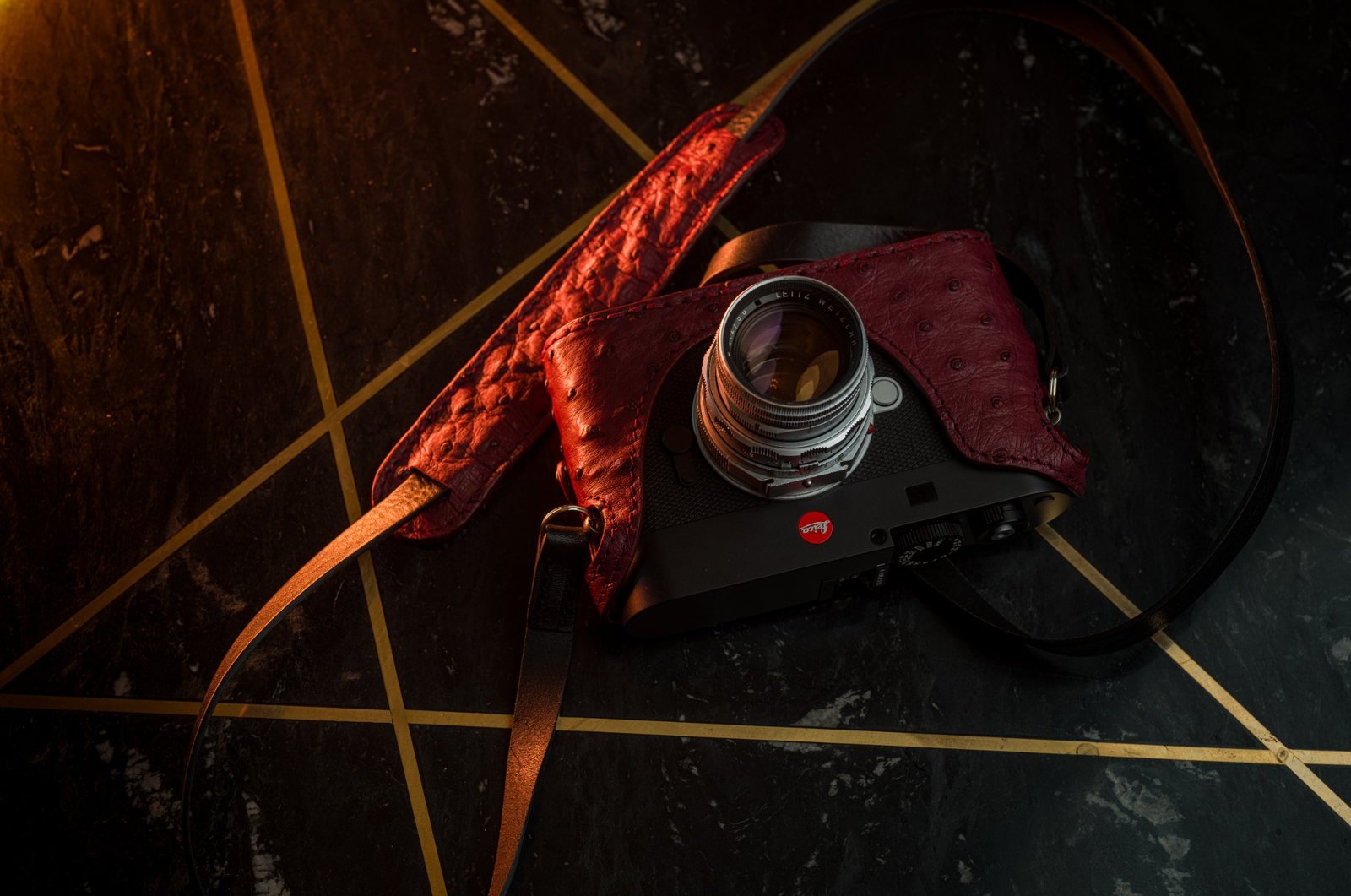
The Leica M EV1 paired with the classic Dual Range Summicron-M 50mm f/2, presented in a distinctive ostrich leather case by Italian artisan Angelo Pelle. A meeting of Leica heritage and traditional craftsmanship.
Stefan explained that the M EV1 is based on the M11 platform and shares many of its components. For him, the Messsucher is not the only defining element of the M system. The native M mount is equally important.
He also made it clear that the camera is not intended to replace the traditional rangefinder. It was developed at the request of long-time M users, while also appealing to photographers who are new to Leica.
As Stefan sees it, the M EV1 simply enlarges the family. Like the Monochrom, the M-D models and the analogue cameras, it offers another interpretation of the M experience. For some photographers, it may even make a very good second body, particularly when working with wide-angle lenses.
Sixty years of Noctilux
Sixty years of Noctilux. The original Leica Noctilux-M 50mm f/1.2 alongside its modern reissue, photographed by Milan Swolfs.
Our conversation eventually moved from cameras to lenses, and there was one particular family I wanted to discuss: the Noctilux.
I had recently written about its sixty-year history, from the original 50mm f/1.2 to the modern 35mm f/1.2. Having owned the original 50mm f/1.2 and spent years exploring the different generations of the Noctilux, it has always been a very personal subject for me.
I wanted to hear how Stefan sees the lens family after spending so many years close to its development.
His answer was interesting because he did not begin with the aperture.
For him, a Noctilux is also about its appearance. The large front element, the beautiful engravings and the proportions of the lens. Even without taking a photograph, he considers it a beautiful object.
That is perhaps part of the fascination. A Noctilux has always been more than a tool for gathering light. It has become one of the most recognisable objects in the Leica world.
The original 50mm f/1.2, introduced in 1966, was particularly important. Stefan sees it as a symbol of the curiosity and ambition of Leica's optical engineers.
The Leica Noctilux-M 50mm f/1 Version 4, designed by Walter Mandler. A landmark in Leica's history of fast lenses.
Producing a lens with two aspherical elements in serial production was an extraordinary undertaking at the time. The engineers did not yet have the same methods available to measure the quality and tolerances of those surfaces that we take for granted today.
It required a willingness to push beyond what was already understood.
For Stefan, that is what makes the original Noctilux so remarkable. It represents the spirit of people who wanted to go further and explore what was possible.
But the purpose of the Noctilux has changed over the years.
When the original f/1.2 was developed, the primary objective was not to create an extremely shallow depth of field. Film was slow, and every additional fraction of a stop could make the difference between getting a photograph and missing it.
Today, modern sensors have changed that equation. Photographers can increase ISO considerably, and a Summicron or Summilux will often be more than sufficient when the only requirement is to gather light.
The Noctilux has therefore become less about necessity and more about rendering.
Stefan believes this is more important than ever. The way a Noctilux draws an image, the transition from sharpness to softness and the particular atmosphere it creates have become central to its appeal.
When I asked him about the latest 35mm f/1.2, his enthusiasm became very clear.
He described it as light enough to carry all the time, exceptionally fast, and capable of rendering like a 35mm APO when stopped down. Yet it retains something that is difficult to describe technically. He called it its built-in "mojo".
Then he said something I particularly enjoyed hearing:
The 35mm Noctilux has become his favourite lens of all time.
That was a lovely connection with my own experience. In my review of the Leica Noctilux-M 35mm f/1.2 ASPH, I described it as perhaps the most practical and versatile Noctilux Leica has ever made. It is a lens that retains the character and magic of the family without demanding the same compromises in size and weight as some of its predecessors.
Stefan's description of it as a lens with its own mojo was perhaps a more direct way of expressing the same thing.
The Monochrom: learning to see light and shadow
Another subject close to my own photography is the Leica Monochrom.
I have used the different generations of the digital M Monochrom, from the original M9 Monochrom through the M Typ 246 and M10 Monochrom to the M11 Monochrom. It remains one of my favourite Leica cameras, particularly for portrait photography.
Stefan confirmed that the Monochrom has become an integral part of Leica's DNA. When the first model appeared in 2012, nobody could have predicted how important it would become. At certain moments, Monochrom cameras represented 20 to 25 percent of total M production.
It is quite remarkable for a camera that began as such a specialised concept.
Interestingly, Stefan himself rarely photographs with a Monochrom. He loves colour and grew up with colour photography. He would use a monochrome camera when colour was no longer part of the question.
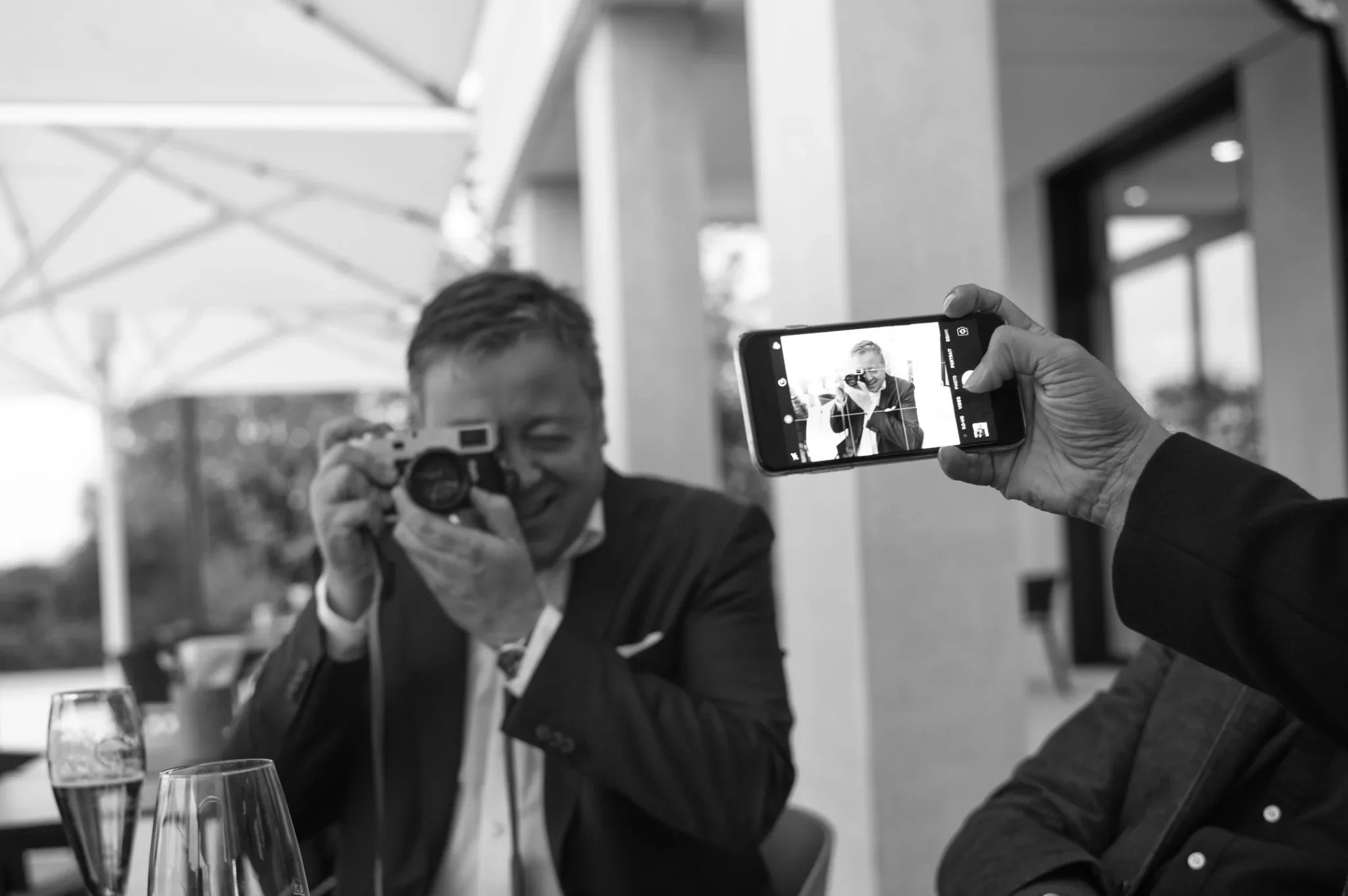
A candid moment with Stefan Daniel, captured in black and white with a Leica Monochrom.
But he remembers a particular moment in Paris in the spring of 2012, shortly before the first Monochrom was introduced.
He was walking around Île de la Cité with the camera and noticed a café with bright red sun blinds. He was attracted to the colour, as anyone might be. Then he suddenly realised that the camera in his hands could not record it.
The red was irrelevant.
He had to start looking at the scene differently. Instead of being drawn to colour, he needed to look for light and shadow.
It was a small moment, but a revealing one.
This is something I have tried to explain in my own long-term review of the Leica M11 Monochrom. For me, using a Monochrom is not simply about converting a colour photograph into black and white. It changes the way I approach a portrait, the light I choose, the lenses I use and even the way I communicate with the person in front of my camera.
When I take a Monochrom to a shoot, the decision is made from the beginning. There will be no colour version afterwards.
Stefan's story from Paris captures that idea beautifully. The camera changes what you look for, even before you press the shutter.
Walter Mandler and the importance of optical heritage
We also returned to the work of Walter Mandler, whose influence on Leica's optical history remains significant.
Stefan mentioned Mandler's 50mm Summicron, introduced in 1979 and still represented in Leica's lens lineup. The original brief was to reduce production costs while improving optical quality.
The result was, in Stefan's words, a stroke of genius.
Wooden Leica M3 camera models created for advertising and display, featuring the iconic M3 design and Summicron lenses. Photographed by Milan Swolfs at Leitz Park.
He particularly admires Mandler's ability to combine optical performance with an understanding of how a lens could actually be manufactured. That balance was important at a time when the photographic market was becoming increasingly competitive and Japanese manufacturers were offering capable cameras and lenses at lower prices.
It is a reminder that optical design is never only about the theoretical performance of a lens. A successful design also has to make sense as a product.
This philosophy is relevant when looking at Leica's modern approach to historic lenses. Stefan explained that the intention behind the Leica Classics line was never simply to reproduce an old lens. The aim was to create a quotation of its historical predecessor: a respectful interpretation rather than a copy.
I particularly like that description.
For many M photographers, a classic lens is another brush in a painter's box. It offers a different way of expressing a photographic vision.
And that is also why the M system continues to be so interesting. The compatibility between generations allows photographers to use lenses with very different histories and characters on modern digital bodies.
When I asked Stefan what makes an M lens special beyond its size and optical performance, he offered another interesting perspective. M lenses often have fewer optical elements than lenses designed for other systems. He sees every piece of glass as something light has to pass through, and wonders whether having fewer elements contributes to a more natural rendering. It is an interesting way of looking at something that is often discussed only in terms of sharpness, contrast and technical specifications.
The story behind the 66mm Summicron
Our conversation about optical heritage brought me back to the Leica Summicron-M 66mm f/2.
As I mentioned earlier, Stefan and I had discussed the original ELCAN lens several years ago. What started as a rather unusual piece of Leica history eventually became a modern limited-production M lens.
Stefan Daniel with the rare Leica ELCAN 66mm f/2, a lens whose unusual story connects Leica's M system with its Leitz Cine heritage. Photographed by Milan Swolfs at the Leitz Café.
During our conversation, Stefan explained two important reasons behind the project.
First, Leica had learned from the Thambar reissue. The initial demand was strong, but the final pieces moved much more slowly. Given the unusual nature of the 66mm lens, Leica decided that a limited production run would be a sensible approach.
There was also a connection with Leitz Cine. The colleagues working on cine lenses needed this focal length and had an optical design for it. An agreement between the teams made it possible for Leica to revisit and adapt the optical design for an M-mount lens. It was an unusual collaboration that helped make the project possible.
It is a rather unusual route for a modern Leica lens, and one of the reasons why I found the project so fascinating.
You can read more about the story and my experience with both the original ELCAN and its modern successor in my Leica Summicron-M 66mm f/2 review.
Hammertone: a finish with a history
We also discussed the Hammertone editions.
Stefan pointed out that the first Hammertone M was not the latest edition. The original idea came from Bill Rosauer of the Leica Historical Society of America (now LSI), resulting in the Hammertone M camera in 2003. Bill deserves recognition for that contribution.

Stefan Daniel and Bill Rosauer, editor of LSI’s Viewfinder, during an evening in Wetzlar.
Stefan likes the finish because it represents something he associates with products made in the 1950s, 1960s and 1970s: reliability, German engineering and craftsmanship.
He told me about a slide projector that belonged to his family. It had not been used for 20 or 25 years. When he switched it on again, it worked as if it had been used the previous day.
That is a very simple story, but perhaps it explains the appeal of Hammertone better than any design presentation could.
For Stefan, the finish is not simply a nostalgic reference. It represents the feeling that something has been built to last.
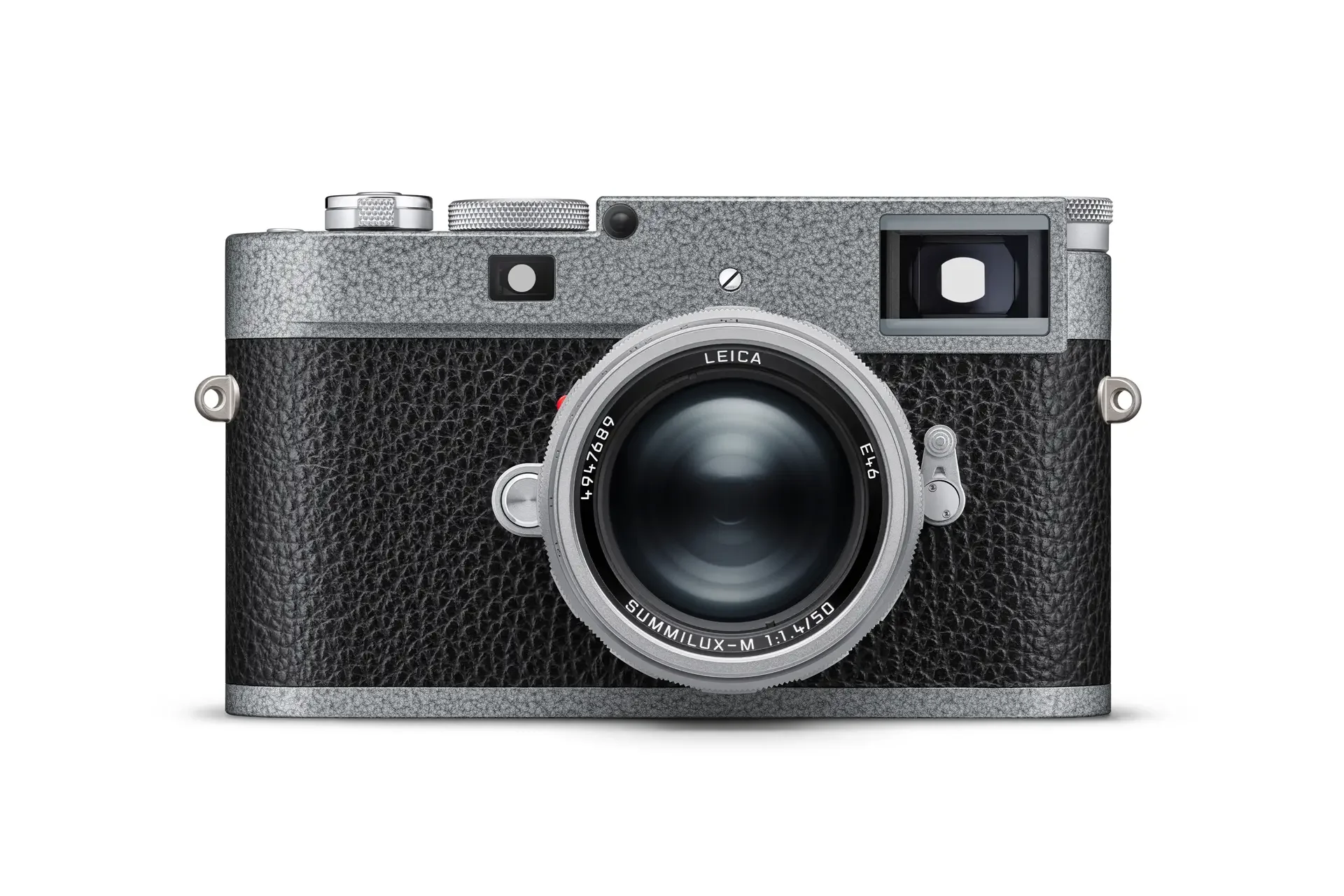
The Leica M11-P Hammertone Special Edition, a contemporary interpretation of one of Leica’s most distinctive finishes. Paired here with the silver Summilux-M 50mm f/1.4 Classic, it brings together a piece of Leica’s design heritage and a modern M camera.
What makes a special edition meaningful?
I also wanted to understand what makes a special edition genuinely meaningful to him.
His answer was one word: credibility.
If Leica works with a celebrity or another brand, it should not simply be because that person is famous. Stefan mentioned Lenny Kravitz as an example. The collaboration made sense because Kravitz is not only a musician. He is also an interior architect, loves photography and grew up with Leica through his father, who was a press photographer.
There is a genuine connection.
The same applies to standalone editions such as Safari or Hammertone. They need to be rooted in Leica's own history and identity.
Stefan also made an important distinction between collectors and photographers.
Leica's core business, he explained, is not about serving collectors alone. It is about making products for people who enjoy photography and want to use their cameras.
But he believes the collector community has changed. Twenty-five years ago, many collectors rarely used their cameras. Today, many are passionate photographers in their own right. They collect, but they also make photographs and remain deeply involved in the photographic community.
He described special editions as the cherry on the cake. They are an important part of the Leica world, but the core business remains the development of new generations of cameras and lenses.
I understand that perspective. I have always believed that a camera or lens should ultimately be used. There are pieces in my own collection that are beautiful enough to spend their lives in a display cabinet, but that is not where the joy of photography lies.
A lens is made to see through, not simply to admire.
One camera, three lenses and a desert island
Stefan Daniel with his Leica R, looking for a photograph at the Leitz Café in Wetzlar. Even after more than four decades at Leica, the pleasure of making pictures remains part of the story.
I finished our conversation with a question I enjoy asking photographers: imagine spending the rest of your life on a desert island. You are allowed to take one Leica M body and three lenses. What would you choose?
Stefan immediately went for an M11 or M11-P. But he admitted that the Hammertone M11-P was tempting him.
For the lenses, his first choice was the 35mm Noctilux.
The second was the 21mm Super-Elmar, a lens he believes is completely underrated and often neglected.
His final choice was his 100mm Macro-R.
It is an interesting combination. A fast and versatile 35mm, a wide-angle lens for landscapes and architecture, and a macro telephoto that opens up a completely different way of seeing.
Stefan explained that with those three lenses he could photograph almost anything he wanted.
I have to admit, it is a rather good kit. And I particularly enjoyed seeing the 35mm Noctilux appear first on his list.
The man behind the M
After more than four decades at Leica, Stefan has witnessed almost every major transformation in modern photography. He has seen the M system move from film to digital, watched the arrival of new technologies and been involved in decisions that have sometimes divided the Leica community.
Yet, listening to him talk about cameras, the most interesting thing is perhaps how often he returns to the physical experience of using them.
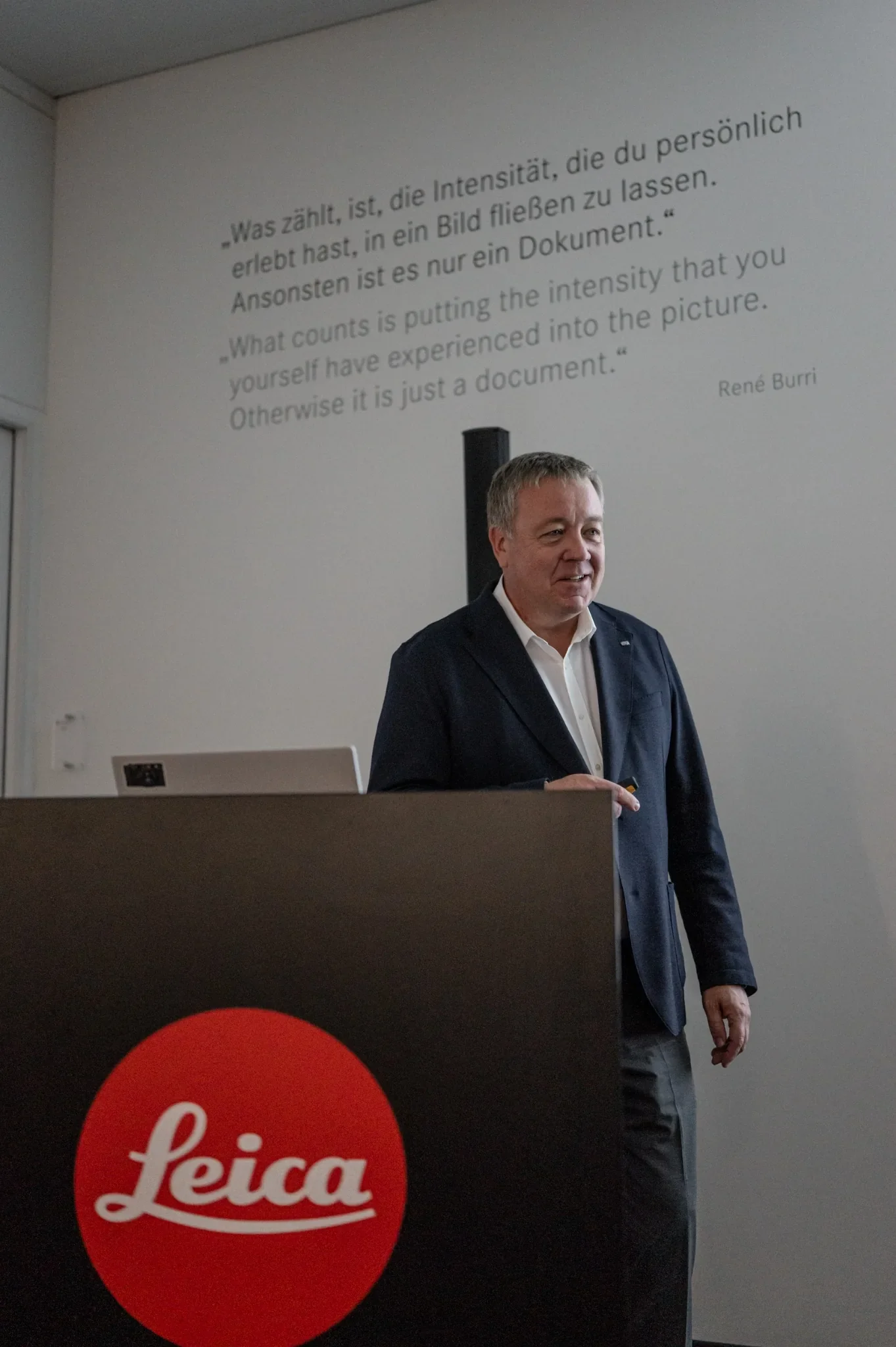
Stefan Daniel looking back at twenty years of digital M photography. Behind him, a quote by René Burri offers a fitting reminder of what photography is ultimately about: bringing something of your own experience into the picture.
The precision of a shutter-speed dial. The feel of a mechanical camera. The importance of listening to photographers. The need to make a lens that not only performs well but also feels right. The difference between preserving a tradition and allowing a product to evolve.
These things are connected.
Stefan believes the emotional bond between Leica and its customers has grown considerably over the years. Very few people buy a Leica for purely rational reasons. There is almost always an emotional connection, creating a community in which customers, photographers, collectors and colleagues share their experiences and enthusiasm across generations. He described it as a family, and said it is a privilege to be part of it.
When I asked Stefan about the people behind the products, he did not want to single out one particular colleague. Instead, he described a team in which people challenge one another strongly, but always with respect and a shared ambition to achieve the best possible result. He jokingly compared this to Getafix's magic potion in their own Gaulish village. It is a charming image, and perhaps a good way of describing the shared knowledge, experience and enthusiasm that go into making a Leica product.
I have always appreciated how approachable Stefan is. Whether we meet in Wetzlar, at an event or during a conversation about a particular lens, he is always willing to talk, exchange ideas and share his knowledge. His presentation on twenty years of digital M photography at COP was another reminder of just how much experience he carries with him, and how generously he shares it.
That is also what makes him such an important person within Leica. He represents a connection between the people who make the cameras and the people who use them. He understands the engineering, the history and the decisions behind the products, but he also understands the passion that makes photographers choose an M in the first place.
For me, that is what makes Stefan Daniel Mr. M. Not simply the number of years he has spent at Leica, or the cameras and lenses he has helped bring to life, but his willingness to keep the conversation going. He is part of what makes Leica feel like a company that listens, remembers and cares about the people behind the cameras.
The M has survived film, digital, changing markets and more than a few debates about what should or should not change. Its future will depend on the people who continue to understand what makes it special. Stefan has spent much of his life doing exactly that.
And perhaps this is the best way I can put it:
The M is more than a camera. It is a conversation between the photographer, the people who made it and the generations who came before. Stefan Daniel has spent more than forty years keeping that conversation alive.
A moment from my visit to the Leica Archive at Leitz Park with Stefan Daniel. Standing among decades of Leica history.
This is the second story in A Life in Leica, an editorial series exploring the people, stories and history behind the Leica world.
About Milan Swolfs
Milan Swolfs is a fine art portrait photographer from Antwerp, Belgium, renowned for his distinctive blend of burlesque and vintage aesthetics. His work channels the timeless Hollywood glamour of the 1920s and 1930s, capturing both men and women in bold yet elegantly refined portraits.
Beginning his career photographing Europe’s largest burlesque events, Milan later transitioned into fine art photography. As an ambassador for Leica Camera and Harlowe Creators, his work has been featured in LFI (Leica Fotografie International), Medium Format Magazine, and Viewfinder. In 2022, he debuted his solo exhibition, Light of Seduction, at the Leica Store in Porto. Most recently, from late 2024 to early 2025, his latest exhibition, Echoes of Elegance: A Timeless Journey, was showcased at the Leica Store Beaumarchais in Paris.
Milan’s portraits celebrate individuality and classic beauty, reviving the charm and allure of a bygone era.
