
There are a few focal lengths I keep coming back to, and 75mm has slowly found its place among them. I have always been a 50mm shooter, and it is still the lens I feel most at home with. The 28mm is often a little too wide for the way I like to photograph, while the 35mm has been finding its way into my bag more and more lately. The 75mm offers something different. It allows me to concentrate on a portrait, separate my subject from the surroundings and still retain enough of the atmosphere to tell a story. I don't reach for it on every shoot, but when I want a tighter frame, it can make all the difference.
Finding the right 75mm is another matter. I have owned and used several of Leica's approaches to this focal length, from the 75mm Summilux-M f/1.4, which I still regret selling, to the modern APO-Summicron-M 75mm f/2 and the 75mm Noctilux-M f/1.25 ASPH, which is currently the only Leica 75mm lens I own. Each has its own character, and that is what interests me most when choosing a lens for portraiture. Sharpness is important, but it is never the whole story. I want to see how a lens renders a face, how the background falls away and what kind of atmosphere it brings to the final image.
I first became curious about the Thypoch Simera 75mm f/1.4 after publishing my review of one of the Light Lens Lab 75mm lenses on the Leica User Forum. In the discussion that followed, S Maclean suggested I give the Thypoch Simera a try. I had been looking for a fast, more compact 75mm for some time, so the recommendation came at just the right moment. It made me curious to see how the Simera would fit into my way of working and how its rendering would compare with the lenses I usually gravitate towards.
With the Thypoch Simera 75mm f/1.4, I was looking for something quite specific. In terms of rendering, I wanted to explore a middle ground between the Leica Summilux and the Leica Noctilux-M 75mm f/1.25 ASPH. I was interested in a modern optical design with a cinematic quality, while retaining enough character to suit the way I photograph. The ability to focus closer was equally appealing, allowing me to move from a portrait to a tighter frame or a small detail without constantly changing lenses.
During a shoot, I often build a series of photographs around a model and the details that establish the atmosphere. I wanted to see whether the Simera would let me move naturally between these different ways of seeing without interrupting the session.
The Simera caught my attention because it appeared to offer that balance. Its design is more contemporary than the vintage aesthetic I usually gravitate towards, but the combination of an f/1.4 aperture, a relatively compact body and a minimum focusing distance of 0.6 metres made it an intriguing proposition. I wanted to find out whether it could deliver the rendering I enjoy in fast Leica lenses while giving me greater freedom to work at different distances.
Specifications can tell me what a lens is capable of on paper, but the photographs will tell me whether it belongs in my camera bag. I wanted to see how the Simera renders faces, how it handles the space around a subject and whether its combination of precision and character would make me reach for it again after the review was finished.
Why I Keep Coming Back to 75mm
Bettie From Hell, photographed in black and white with the Simera 75mm f/1.4 on the Leica M11 Monochrom.
For me, 75mm is an especially rewarding focal length for environmental portraiture. It gives me enough reach to bring a subject forward, while leaving room for the setting to contribute to the photograph. I find this particularly useful when working in interiors with their own character, whether an old house, a hotel room or a carefully arranged set.
For a long time, I had been looking for a fast 75mm lens that would be lighter and more compact without giving up the f/1.4 aperture I wanted for portraiture. The Thypoch Simera 75mm f/1.4 has become that lens for me. A 75mm is a standard part of my kit, and I enjoy bringing this focal length to almost any shoot. It gives me a natural working distance for portraits while allowing me to isolate a subject and shape the frame with a little more intention than I can with my usual 35mm or 50mm lenses. The Simera makes that familiar focal length easier to carry and more versatile to use.
I particularly enjoy using 75mm in interiors with a strong sense of place. It lets me simplify a busy room and give the subject greater prominence without losing the details that make the setting interesting. That balance is what keeps me returning to the focal length.
I also use the 75mm to pick out details that might otherwise be lost within a larger scene: a gesture, a piece of jewellery, the texture of a dress or an object that contributes to the mood. These details can give a sequence of portraits a stronger sense of narrative, and the ability to focus closer makes it easier to explore them during a shoot.
Of course, the focal length is only part of the equation. Two 75mm lenses can frame a subject in exactly the same way and still produce very different photographs. The transition from sharpness to blur, the handling of contrast and the way a lens draws light all contribute to that difference. With the Simera, I was particularly interested in how its modern optical design would translate into a rendering with a cinematic quality.
Thypoch: Looking Backwards Without Standing Still
I first explored Thypoch through the Ksana 21mm f/3.5, which I reviewed previously on my blog. It was an interesting starting point because 21mm sits well outside my usual comfort zone. I have always been a dedicated 50mm shooter, and it remains the focal length I feel most at home with. Lately, however, I have also been working more frequently with 35mm and 75mm lenses, exploring different ways to frame my subjects and include the atmosphere around them. The 21mm challenged me to approach a scene differently, paying closer attention to the edges of the frame and the relationship between the subject and the surrounding space.
The Ksana 21mm challenged me to approach a scene differently. With such a wide field of view, I had to pay closer attention to the edges of the frame and to the relationship between the subject and the surrounding space. It remains a gorgeous lens, and I enjoyed working with it. The experience also reminded me that a lens can be beautiful and inspiring without necessarily becoming one I reach for during every shoot.
My experience with the Ksana 35mm f/2 was a more natural fit. Its vintage-inspired appearance, brass construction and old-school character are much closer to my personal taste. I have always been drawn to lenses with a sense of history in their design, and the Ksana range speaks that language particularly well.
Thypoch's approach becomes particularly interesting when considering its connection with DZOFilm, known for its cinema lenses. That background provides useful context for the attention Thypoch gives to rendering and image character. Resolution is only one part of the picture; the way a lens draws a subject, transitions into the background and handles light also shapes the final image.
The Simera family takes a more contemporary approach to exterior design, which initially made it less immediately appealing to me than the vintage-inspired Ksana range. Using the Simera 28mm f/1.4 II, however, gave me a reason to look beyond appearance and pay closer attention to what the lens could do in practice.
The Thypoch Simera 75mm f/1.4 alongside a Leica M, fitted with an Angelo Pelle leather case and a Louis Vuitton strap customised by Kevin Fickling.
I am still learning to tame that 28mm. It challenges me to think differently about composition, particularly when working with environmental portraits. In Nice, I brought the lens with me and appreciated how it allowed me to keep the surroundings involved in the photograph. Architecture, available light and the atmosphere of a location can become part of the portrait, rather than simply forming a background behind the subject. It is a wonderful tool for this kind of work, even if I am still discovering everything it can do.
Using both the Simera 28mm f/1.4 II and the 75mm f/1.4 has helped me understand where each fits into my work. The 28mm encourages me to build a composition around the subject, using layers and the surrounding environment. The 75mm lets me be more selective, bringing the subject forward while retaining enough context to establish a mood. I still reach most naturally for my 35mm and 50mm lenses, but the 75mm has earned a distinct role in my kit.
I appreciate that Thypoch has developed two distinct design languages. The Ksana range speaks to my love of vintage styling, while the Simera lenses take a more contemporary approach. What interests me is how both families explore image character in their own way.
That was the background I brought to the Simera 75mm f/1.4. I already knew the brand, understood some of its strengths and had experienced the different demands of its lenses. This time, I was looking for a fast short telephoto that could combine cinematic rendering with the flexibility to move from environmental portraits to tighter compositions and details. I wanted to see whether the Simera could deliver that balance in practice.
One thing I genuinely admire about Thypoch is that the company is building distinct families of lenses with a recognisable identity. The Simera 75mm f/1.4 feels closely related to the Simera 28mm f/1.4 II, not simply in its exterior design and build quality, but also in the way the lens approaches rendering. They have different focal lengths and serve different purposes in my photography, yet there is a sense of consistency between them.
I feel something similar when using the Ksana 21mm f/3.5 and 35mm f/2. They share a visual language in their construction and styling, but the connection goes beyond their brass finishes and vintage-inspired appearance. There is also a common sensibility to their rendering that makes the lenses feel like part of the same family.
For a photographer, that sense of consistency can be appealing. It allows different focal lengths to serve different purposes while retaining a recognisable identity, even when the two families approach design and rendering so differently.
The Design: Not Quite My Kind of Vintage
The Simera 75mm f/1.4 on my Leica M11 Monochrom. I appreciate the clean design, even if my taste usually leans towards vintage lenses.
If I am honest, the design of the Thypoch Simera 75mm f/1.4 would not be my first choice based on appearance alone. I have a soft spot for lenses that look as though they have stepped out of another era. The brass construction and old-school styling of the Ksana 35mm f/2, for example, appeal to me immediately. The Simera takes a more contemporary approach, with a design that feels cleaner and more technical. It is well made, but it does not have quite the same visual charm for me.
That said, I appreciate that Thypoch has developed its own identity rather than simply reproducing the appearance of a vintage lens. The Simera has its own design language, and some of its details reveal a thoughtful approach to how a lens should be used. The focus scale, for instance, draws inspiration from the Visifocus systems associated with the 1950s. It gives the lens a subtle historical reference without turning the entire design into a replica of something from the past.
The focus markings also caught my attention because they reminded me of the Alpa Kern Macro-Switar AR 50mm f/1.9. There is a visual similarity in the way the focusing information is presented, which I found interesting given my appreciation for older optical designs. It is a personal association rather than a judgement about the origins of the Simera's design, but it is one of those small details that makes you look twice.
The aperture ring is another practical touch. The ability to switch between clicked and clickless operation makes the lens more versatile, whether I am working on still photographs or want to make smooth aperture adjustments while recording video. It is a feature that fits the broader connection between Thypoch's photographic lenses and the company's interest in cinematic optics.
I also appreciate that Thypoch includes both a metal front lens cap and a metal lens hood. These are small details, but they feel appropriate on a lens in this category. The cap feels solid and well made, while the hood is a nice addition. In practice, I tend to leave the hood at home, as I prefer to shoot without it. Still, I appreciate having it included rather than having to purchase it separately.
There is, however, one small omission I would have liked to see addressed. I miss a clear mounting alignment indicator on the lens. When changing lenses during a shoot, particularly when moving between focal lengths, a visible alignment mark makes mounting quicker and more intuitive. It is a minor detail, but one I notice when working at a steady pace.
Modern Engineering: The Thypoch Simera 75mm f/1.4 Explained
The Simera 75mm f/1.4, photographed in the warm light of an afternoon.
Before looking at the rendering in more detail, it is worth understanding what Thypoch has built into the Simera 75mm f/1.4. On paper, it is a fast short telephoto for the Leica M system, but some of the more interesting decisions become apparent when you look beyond the headline specifications.
Thypoch Simera 75mm f/1.4: Specifications
• Mount: Leica M • Focal Length: 75mm • Aperture Range: f/1.4 to f/16 • Optical Construction: 9 elements in 8 groups • Special Elements: 1 aspherical, 2 HRI and 2 ED elements • Minimum Focus Distance: 0.6 m • Filter Size: 58 mm • Length: 64–78 mm without hood, depending on configuration • Weight: Approximately 372 g • Aperture Blades: 16 • Focus: Manual • Image Coverage: Full-frame, specified as a 43.2 mm image circle
The combination of a maximum aperture of f/1.4, close focusing down to 0.6 metres and a weight of approximately 372 grams makes the Simera an interesting proposition for portrait photographers. It offers considerable control over depth of field without the physical bulk I associate with some of the fastest lenses in this focal length.
The 16-blade aperture is another unusual specification. Most photographers will first think about the smoothness of the out-of-focus areas, but the number and shape of the aperture blades also influence how the diaphragm looks as the lens is stopped down. Thypoch designed the aperture to remain close to circular, while point light sources can produce a distinctive 16-point starburst under suitable conditions.
The thinking behind the optical design
I asked Elena at Thypoch to explain some of the decisions behind the Simera 75mm. The optical formula consists of nine elements arranged in eight groups, including one aspherical element, two high-refractive-index elements and two extra-low-dispersion elements.
Each type of glass serves a different purpose. The ED elements help control chromatic aberration, while the aspherical element helps manage spherical aberration and astigmatism, particularly when shooting at wider apertures. The HRI elements allow the designers to control the path of light through the lens while balancing optical performance against size and weight.
The aim was not simply to maximise sharpness. According to Elena, the design process involved balancing resolution, chromatic aberration, field curvature, astigmatism, coma and the transition from the in-focus subject to the out-of-focus background. These characteristics interact with one another, and optimising one can affect another.
That balance is particularly relevant to a lens designed to be used at f/1.4. At such a wide aperture, the optical design has to manage a very shallow plane of focus while retaining enough detail and contrast for the subject to remain clearly defined. For portraiture, this relationship between the focused area and everything around it is an important part of a lens's personality.
Floating focus and the close-focusing advantage
One of the more interesting features is the floating-focus system. Rather than moving every optical element together as the lens focuses, selected groups move relative to one another. This allows the optical correction to be adjusted as the focusing distance changes.
According to Thypoch, the system helps maintain performance across different focusing distances. It is particularly relevant here because the Simera combines a fast f/1.4 aperture with a minimum focusing distance of 0.6 metres.
The practical benefit is straightforward: the Simera lets me focus closer than many rangefinder lenses, making tighter compositions possible without reaching for another lens. The following limitation is worth understanding, however, particularly when using it on a Leica M.
There is an important distinction when using the lens on a rangefinder camera, however. The Simera can focus closer than the distance at which the Leica M rangefinder mechanism can accurately indicate focus. Thypoch has incorporated a tactile resistance point around 0.7 metres to alert the photographer that this limit is approaching. To focus accurately at closer distances, you need to use live view or an electronic viewfinder, where available.
A photographic lens with a cinematic connection
Thypoch also explained that the Simera 75mm f/1.4 shares its optical design with the Simera-C 75mm T1.5 cinema lens. The photographic version has been adapted for still photography, while the cinema version has its own mechanical and operational requirements.
The company wanted to retain the cinema lens's out-of-focus transitions, bokeh character and overall atmosphere in the M-mount version. This is an interesting approach because it suggests that the visual character of the lens was considered alongside its resolution and aberration control from the beginning.
The 16-blade diaphragm is part of this thinking, carrying over the design language of the Simera-C range. For still photographers, it offers a practical benefit when stopping down, while also contributing to the way the lens renders out-of-focus highlights.
Elena also explained that Thypoch did not attempt to eliminate every optical imperfection. In particular, the designers chose not to fully eliminate vignetting effects in out-of-focus highlights. Under certain conditions, point light sources towards the edges of the frame can therefore produce slightly lemon-shaped bokeh rather than perfectly circular highlights.
I find this approach worth exploring in practice. Technical correction matters, but a lens's character is also shaped by the decisions its designers make about which optical traits to preserve. Whether those choices work for a particular photographer ultimately depends on the images being made, the light and the composition.
The specifications and Elena's explanations give us a clearer picture of the thinking behind the Simera 75mm f/1.4. The next step is to look at how that design translates into actual photographs, where sharpness, focus transitions, bokeh and the handling of light become much more than technical terms.
A Few Details That Matter in Practice
A glimpse into Bettie's world, where every corner has a story to tell.
Specifications tell only part of the story. When I use a lens during a portrait session, I become just as interested in the small practical details as I am in its optical performance. They can make the difference between a lens that works naturally with my way of shooting and one that requires a little more thought.
The first is the close-focusing capability. The Simera 75mm focuses down to 0.6 metres, which gives me more room to experiment with tighter compositions and details. With a model, I might begin with a portrait that includes some of the surroundings, then move closer to concentrate on the face, jewellery or a particular gesture. That flexibility is especially useful when I want to tell a story through a sequence of images without constantly changing lenses.
On a Leica M rangefinder, however, it is important to remember that the rangefinder itself cannot provide accurate focusing at the lens's closest distances. Thypoch has added a tactile resistance point around 0.7 metres to indicate that you are approaching this limit. Beyond it, live view or an electronic viewfinder becomes necessary for accurate focusing. It is a sensible reminder, although it does mean adjusting your way of working if you regularly move between normal rangefinder distances and close-up compositions.
The aperture ring offers another useful option. You can choose between clicked and clickless operation, making the lens suitable for photographers who prefer tactile steps when changing aperture and those who want smoother adjustments for video. I appreciate this kind of flexibility, even if my own evaluation is primarily concerned with still photography.
The 16-blade diaphragm is also worth mentioning in practical terms. Besides helping the aperture remain close to circular as you stop down, it can create a distinctive 16-point starburst around point light sources. The effect depends on the light source and shooting conditions, so it is something to explore rather than an effect to expect in every photograph.
Finally, there is the mounting alignment indicator I mentioned earlier. I would have preferred a clearer visual reference when attaching the lens to the camera. It is a minor omission, but during a shoot, when I am moving between focal lengths and trying to maintain a particular rhythm, these small details become noticeable.
These practical details help explain what it is like to work with the Simera. What interests me most, however, is how its optical design translates into photographs, particularly in the way it renders faces, background detail and light.
The Rendering: Sharpness, Character and Cinematic Soul
The Thypoch Simera 75mm f/1.4 is a lens I have come to appreciate for its balance. It has the sharpness and contrast I want from a modern optic, yet it retains enough character to keep the images from feeling clinical. The bokeh is beautiful, the rendering feels cinematic, and the colours are natural, particularly when photographing skin. For my work, that combination is much more interesting than sharpness alone.
I have a particular affection for vintage lenses with a distinctive rendering. The Leica Thambar-M 90mm f/2.2, for example, can produce a wonderfully unusual image when the circumstances call for it. But I would not want to photograph every subject with that kind of pronounced optical character. Used constantly, even something as beautiful as the Thambar could become a gimmick. I want the freedom to choose a lens with a particular personality when it serves the photograph, while keeping other lenses in my bag that offer a more versatile balance.
The Simera 75mm fits that role very well. Its rendering is more modern than that of the vintage-inspired lenses I usually gravitate towards, including Thypoch's own Ksana range, but it still feels at home in my work. What I particularly appreciate is the way the background supports the subject rather than competing for attention.
At f/1.4, the Simera gives me the shallow depth of field I enjoy in portraiture without sacrificing the definition I want around the eyes. It is an aperture I feel comfortable using throughout a shoot, rather than reserving it for occasional effects.
At closer distances, the shallow depth of field demands a little more care, especially when I want both eyes to remain sharp. Stopping down slightly gives me more room to work while preserving the separation from the background that makes these intimate portraits so effective.
The handling is equally reassuring. The focusing ring is exceptionally smooth, with a resistance that makes manual focusing feel natural. The aperture clicks are positive and well defined, and the overall build quality feels excellent. These details might seem minor on paper, but they contribute to the pleasure of using a lens during a shoot.
Compared with my Light Lens Lab Z21 75mm f/1.5, the Simera takes a different approach. The Z21 has a wilder, more vintage character that I find a joy to bring to a shoot, particularly when I want a rendering that feels less predictable. The Simera is faster at f/1.4, sharper in my experience, shorter and capable of focusing closer. It is also lighter than the Leica 75mm Noctilux. These practical advantages make it a compelling alternative, but they do not make the Z21 any less special to me. I am still drawn to the character of vintage optics, and I would choose between these lenses according to the photographs I want to make. The Simera offers a more modern and balanced rendering, with enough character to keep it from feeling clinical.
Wide Open, Stopped Down and Working with Flare
What interests me most at f/1.4 is the transition from the focused subject into the background. The Simera keeps the eyes and facial details well defined, while the gradual fall-off gives the portrait depth without making the surroundings feel disconnected from the subject.
When a portrait calls for more definition across the face, I stop down slightly. The background can remain soft while the extra depth of field gives me more confidence in the focused area. It is a simple adjustment, but one that lets me adapt the rendering to the portrait rather than commit to a single look.
I have also been impressed by the Simera's resistance to flare. Even when working with strong light sources, I have found it capable of maintaining good contrast and a clean image. At the same time, I have managed to create some beautiful flare that I genuinely enjoy in my photographs. Depending on the position of the light, it can introduce a subtle glow and an extra layer of atmosphere without taking away from the subject.
Laura D. photographed directly into a Harlowe light. The Simera handled the flare beautifully.
I would not want every lens to eliminate flare so completely that there is no room to use it creatively. Sometimes I want the light to become part of the photograph, adding to its mood rather than simply illuminating the scene. What I appreciate about the Simera is that it has performed well when I want a controlled image, while still allowing me to explore flare when the composition and lighting come together.
Little Shop of Curiosities
Reflections, Red Light and the Art of Seeing
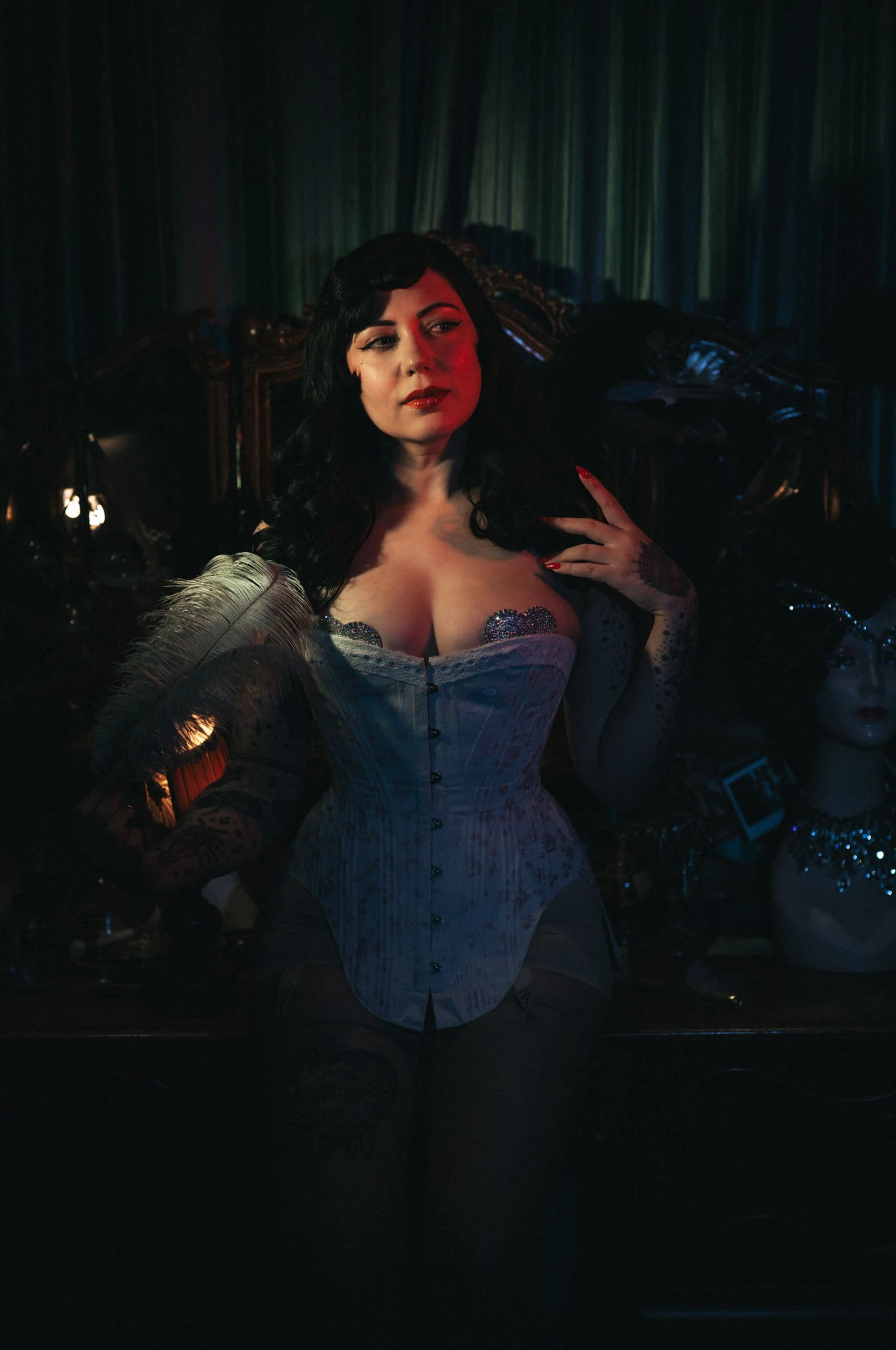
I saw this particularly clearly during Little Shop of Curiosities, a shoot I created with Bettie From Hell, also known as Rosana. I brought three lenses with me: a 35mm, my trusty 50mm and the Simera 75mm f/1.4. The plan was to use the 75mm mainly for tighter portraits and details, while relying on the wider lenses to establish the scenes inside her home. In practice, I found myself reaching for the 75mm far more often than I had expected.
Bettie From Hell in a cinematic portrait made with the Thypoch Simera 75mm f/1.4 on the Leica M11-D.
There is something interesting about photographing in another person's home. The objects, furniture and decorations are already part of their world, and I wanted to use them to build the story rather than treat them as a backdrop. Rosana's home was full of curious details, unusual objects and vintage furniture, making it a natural setting for the concept. I also wanted to work with mirrors, something I enjoy incorporating into my portraits because they introduce another layer to the composition and create opportunities to play with reflections, light and ambiguity.
One of my favourite setups was at the vintage makeup table in the bedroom. The table stood close to the bed, which left me with limited room to move. I wanted a relatively tight portrait, but I also had to consider the mirror. I did not want my own reflection to appear in the frame. A 35mm or 50mm might seem the more obvious choice in such a confined space, yet the 75mm turned out to be ideal. Its additional reach allowed me to compose the image from the position I needed, keeping myself out of the reflection while bringing Rosana forward in the frame.
The photograph with the flowers in the foreground shows what I mean. The blurred flowers, the reflection and the warm red light create several layers, while Rosana's face remains the natural point of attention. The foreground blur adds a slightly mysterious quality to the image, almost as though we are looking into a private moment from behind another object. The lens renders these layers beautifully. The background remains soft, but the bokeh does not become so pronounced that it competes with the subject.
Bettie From Hell at her makeup table, surrounded by warm light and reflections. Shot with the Thypoch Simera 75mm f/1.4 on the Leica M11-D.
For this shoot, I used a three-light Harlowe LED setup, working with coloured light to give the different scenes their own atmosphere. The battery-powered lights made the process considerably easier. I could reposition a light when the composition changed without being restricted by power cables, which is particularly useful when working in a small bedroom filled with furniture. I enjoy using light to create a sense of mystery, and the Simera handled the illuminated areas and coloured reflections in a way that worked beautifully with the look I wanted.
The other portrait from the makeup table opens up the composition a little more. We see more of the corset, the furniture and the dark surroundings, yet the subject still holds our attention. The contrast gives the scene depth, and the colours remain rich without making the skin look unnatural. That last point matters to me. With coloured lighting, it is easy for skin tones to become unpleasant or for the colours to dominate everything else in the frame. Here, the Simera preserves a natural-looking rendering of the skin while allowing the red and cooler tones to shape the mood.
I have also noticed very little in the way of distracting optical aberrations in the images I have examined so far. That is an encouraging result, particularly given the way I work with contrasting light sources and coloured illumination. I will continue to look at the files more closely, but my initial experience has been positive. The lens gives me the detail and contrast I need without sacrificing the atmosphere I am trying to create.
What surprised me most was how naturally the 75mm fitted into a shoot that was not designed around it. I had brought it mainly for tighter portraits, but it also helped simplify busy surroundings and build compositions around reflections, foreground objects and coloured light.
The experience reinforced something I value in a lens: it should support the way I see a scene without dictating how every photograph must look. The Simera gave me that freedom during this shoot, while adding a rendering that suited the atmosphere I wanted to create.
The Thypoch Simera 75mm f/1.4 on the Leica M11 Monochrom
Gentle Tones, Deep Shadows and a Touch of Darkness
Bettie From Hell in a dark, vintage-inspired Halloween portrait, photographed with the Thypoch Simera 75mm f/1.4 on the Leica M11 Monochrom.
The Thypoch Simera 75mm f/1.4 is a beautiful lens in colour, but I also wanted to explore what it could bring to my black-and-white work with the Leica M11 Monochrom. To my eyes, the Monochrom reveals a little more of the lens's fine detail and texture, producing striking black-and-white images with excellent sharpness and contrast. Yet the rendering never feels clinical. Compared with the lenses I usually use on the Monochrom, the Simera has a more modern character, while retaining the gentle transitions and atmosphere I look for in a portrait lens.
I found the combination equally useful for half-body portraits and tighter compositions. For close portraits where I wanted both eyes to remain sharp, I stopped down slightly. I used this approach during my shoot with Bettie From Hell, also known as Rosana, where I photographed mostly in colour before moving into black and white to explore a different atmosphere.
We photographed the series shortly before Halloween, and I wanted to create something with the feeling of a vintage Halloween celebration, inspired by the way the occasion might once have been imagined. Rosana understood the idea immediately. Her beautiful home is filled with memorabilia and curious objects, including skulls that became part of the story. By playing with these elements, I wanted to create a contrast between the beauty of the model and a slightly darker, more mysterious atmosphere.
In one of the portraits, Rosana holds a skull while a fox remains visible in the background. The objects give the image a sense of narrative without overwhelming the portrait. There is beauty in the pose and the expression, but also something unsettling in the details around her. The Simera helps hold these elements together. The subject remains clearly defined, while the background and surrounding objects fall away with a softness that gives the image its atmosphere.
Light was equally important. I used a Harlowe 300W LED light with an octagonal softbox to create illumination that resembles soft natural daylight. It is artificial light, carefully shaped to feel gentle and believable. The reflection in the eyes adds life to the portrait, while the light falling across the face gives the monochrome images a lovely range of tones. The Simera's contrast and fine detail work beautifully with the Monochrom's black-and-white rendering, giving the portrait both definition and atmosphere.
In post-processing, I added a little grain and deepened some of the shadows in the hair. I also used dodging and burning to guide the eye and bring out certain details. These were subtle adjustments rather than an attempt to rescue the files. Most of the images already looked very good straight out of the camera, with the tonal structure and separation I wanted largely present from the start.
Bettie From Hell with a skull in a dark, vintage-inspired portrait, shot on the Leica M11 Monochrom with the Thypoch Simera 75mm f/1.4.
Working with the Simera on the M11 Monochrom has shown me another side of its rendering. The additional texture and definition I see in black and white, combined with the lens's strong contrast, can give a portrait a striking presence. This is a different quality from the natural colours and beautiful skin tones I enjoy when using the lens in colour, rather than a reason to prefer one over the other.
What I particularly enjoy is that the images already have the contrast and texture I want before I begin editing. A little grain, careful dodging and burning, and some adjustment to the shadows are enough to shape the final atmosphere without having to force a particular look onto the files.
Portraits Through the Simera 75mm f/1.4




Who Is the Thypoch Simera 75mm f/1.4 For?
I think the Thypoch Simera 75mm f/1.4 will appeal most to photographers who enjoy portraiture but want more from a lens than simply isolating a face against a blurred background. Its focal length gives a subject prominence while leaving enough room for the surroundings to contribute to the photograph. That makes it particularly interesting for environmental portraits, fashion, editorial work and the kind of visual storytelling I enjoy.
Its f/1.4 aperture makes it particularly appealing to photographers who often work in available light or want greater control over depth of field. I found it versatile across both colour and black-and-white photography, with enough definition for detailed portraits and enough character to preserve the atmosphere I look for in my work.
I would also recommend it to photographers who like to work through a scene rather than commit to a single type of image. The close-focusing capability is useful when moving from a portrait to a smaller detail, and the lens proved more versatile than I initially expected during Little Shop of Curiosities. It became part of the storytelling rather than simply a tool for tighter framing.
There are a few things to consider before buying it. The Simera's design is more contemporary than the vintage-inspired lenses I naturally gravitate towards, and photographers who particularly enjoy the look and feel of traditional brass lenses may not find it as immediately appealing. Its close-focusing ability also comes with a practical consideration on Leica M rangefinder cameras: beyond the rangefinder's focusing limit, live view or an electronic viewfinder is needed for accurate focus.
For me, the Simera 75mm f/1.4 makes the most sense for someone who wants a fast, capable portrait lens with a distinctive rendering, but without an overly pronounced vintage effect. It has enough precision for detailed portraits, enough character to create atmosphere and enough flexibility to work across different kinds of scenes.
That combination is what makes it interesting.
Conclusion: Modern Precision, Cinematic Soul
Bettie From Hell in Little Shop of Curiosities, photographed with the Thypoch Simera 75mm f/1.4 on the Leica M11-D.
When I first picked up the Thypoch Simera 75mm f/1.4, I wanted to find out whether a modern optical design could offer the sharpness and contrast I appreciate while retaining the character I look for in a portrait lens. After using it across different subjects, lighting conditions and both colour and black-and-white photography, I have come to appreciate its particular balance. The natural skin tones, cinematic rendering and beautiful subject separation make it a versatile lens, while its modern character gives it a distinct place in my kit.
What I appreciate most is the way the lens allows me to work. The 75mm focal length brings a subject forward without completely separating her from the environment. The f/1.4 aperture gives me beautiful subject separation, while the gradual fall-off helps preserve a sense of depth. Being able to focus closer adds another dimension, allowing me to move between portraits and details without constantly changing lenses.
The shoot with Bettie From Hell during Little Shop of Curiosities confirmed how naturally the lens fits into my way of working. I used it to build compositions around mirrors, reflections, coloured light and the objects in her home. The M11 Monochrom revealed another side to its rendering, particularly in the way it handles tonal transitions and shadow.
The Simera is not a vintage lens in appearance, nor does it attempt to reproduce the unmistakable character of a classic optic. Its approach is more contemporary, and there are small practical details I would like to see improved, particularly the mounting alignment indicator. The need to switch to live view or an electronic viewfinder for accurate focusing at the closest distances is also worth remembering when using it on a Leica M.
These are considerations rather than reasons to dismiss the lens. In practice, its rendering and handling matter far more to me than a few design details, and the Simera has consistently given me the control I need to work with light, depth and atmosphere.
I still reach most naturally for my 35mm and 50mm lenses, but the Simera 75mm f/1.4 has become a lens I appreciate having with me when I want tighter portraits, greater subject separation or the opportunity to explore smaller details. I had been looking for a fast, more compact 75mm for a long time, and the Simera offers the flexibility I wanted without losing the cinematic quality that matters to me.
The Thypoch Simera 75mm f/1.4 is more modern in both design and rendering than the lenses I usually gravitate towards. Yet after looking for a fast, more compact 75mm for so long, I have found a lens that fits naturally into my way of working. It gives me the speed, definition and flexibility I wanted, while retaining the cinematic quality that matters to me.
I remain drawn to vintage rendering, and that has not changed through my experience with the Simera. I enjoy its natural colours and beautiful subject separation, and it handles contrast and texture just as confidently in black and white. For me, this is not about finding one lens that does everything best, or replacing the character of the lenses I already love. It is about having another way to approach a photograph, and knowing when that particular rendering is right for the image I want to make.
Special Black Friday Offer for My Readers
If you have been considering the Thypoch Simera 75mm f/1.4, Black Friday is a good opportunity to take a closer look. From 20 October to 3 December 2026, Thypoch is offering the lens for €609 instead of €799, a saving of €190 (approximately 24%).
You can find the lens directly through my dedicated affiliate link below. The link helps track purchases made through my review, at no additional cost to you.
👉 Shop the Thypoch Simera 75mm f/1.4 – Black Friday Offer
Please note that my usual MILANSWOLFS discount code, which offers 5% off and free worldwide shipping, is temporarily unavailable during the Black Friday promotion. The code will be available again after 3 December 2026.
The Simera 75mm f/1.4 is an interesting proposition for photographers looking for a fast portrait lens with modern optical performance and a cinematic quality. Its compact design, close-focusing capability and balanced rendering make it a versatile option for portraiture and visual storytelling.
A final thank you
A special thank you to Elena and the team at Thypoch for their help and for giving me the opportunity to explore the Simera 75mm f/1.4 in my own way. I particularly appreciate being able to take the time to use a lens in real photographic situations, rather than simply looking at its specifications.
I would also like to thank Bettie From Hell and Laura D for their time, creativity and trust in front of the camera. Their contribution helped bring the photographs in this review to life, each in her own way.
For me, a lens review is about more than describing optical performance. It is about discovering what a lens can contribute to a photograph, and the people, ideas and moments that make those images possible. I am grateful to everyone who helped make this review happen.
About Milan Swolfs
Milan Swolfs is a fine art portrait photographer from Antwerp, Belgium, renowned for his distinctive blend of burlesque and vintage aesthetics. His work channels the timeless Hollywood glamour of the 1920s and 1930s, capturing both men and women in bold yet elegantly refined portraits.
Beginning his career photographing Europe’s largest burlesque events, Milan later transitioned into fine art photography. As an ambassador for Leica Camera and Harlowe Creators, his work has been featured in LFI (Leica Fotografie International), Medium Format Magazine, and Viewfinder. In 2022, he debuted his solo exhibition, Light of Seduction, at the Leica Store in Porto. Most recently, from late 2024 to early 2025, his latest exhibition, Echoes of Elegance: A Timeless Journey, was showcased at the Leica Store Beaumarchais in Paris.
Milan’s portraits celebrate individuality and classic beauty, reviving the charm and allure of a bygone era.
