
Leica Summicron-M 66 f/2 Review: The Remarkable Story of the ELCAN
There are Leica lenses that every photographer knows. The ELCAN 66mm f/2 isn't one of them.
I first spoke about this lens with Stefan Daniel during the Leica Oskar Barnack Award in 2023. At the time, it felt like one of those fascinating pieces of Leica history that would never leave the Leica Archives. The original lens was almost impossible to find outside a handful of private collections, and the only example I had seen was part of the Rolf Fricke Collection in the Leica Archives.
That changed when Leica invited me to Wetzlar to photograph with the new Leica Summicron-M 66 f/2.
Tim Pullmann comparing the new Leitz Summicron-M 66 f/2 with the original ELCAN 66mm f/2 in the Leica Archives, Wetzlar. Photographed on an iPhone 15 Pro during my visit to Leica Camera AG.
The visit became much more than a chance to use a lens. Over the course of two days I spent time with Murat Akkas, Product Manager for Leica M lenses, met Tim Pullmann in the Leica Archives, where he generously shared his knowledge of the original ELCAN, several other military lenses and the renowned Rolf Fricke Collection. I had a long conversation with Stefan Daniel about how this unusual project came to life. Together, those conversations answered many of the questions that have surrounded the ELCAN for decades, while also showing that some parts of its history remain incomplete.
Unlike most Leica lenses, the ELCAN was never intended for the civilian market. Designed by Dr. Walter Mandler at Ernst Leitz (Canada) Ltd. (ELC), the lens itself carried the ELCAN name that was reserved for military products, while the company continued to use Ernst Leitz Canada for its civilian business. It was developed for military use during the Cold War, where high resolving power and a discreet appearance were considered equally important. Even today, Leica's own archive contains surprisingly little documentation about its development, making the surviving lenses themselves some of the most important historical records.
This article combines those conversations with my own experience photographing with both the original archive lens and its modern successor around Leitz Park. Rather than looking only at image quality, I wanted to understand why Leica chose to bring back one of its least familiar lenses, what remained faithful to the original design, and where the new version inevitably differs.
Some lenses are remembered for the photographs they produce. Others are remembered for the stories they carry. The ELCAN belongs to both.
To avoid confusion throughout this article, I refer to the original military lens as the ELCAN 66mm f/2, reflecting the name engraved on the historic lens itself. The modern reissue is officially named the Leitz Summicron-M 66 f/2. After its first mention, I simply refer to it as the Summicron-M 66 f/2. References to "Leica 66/f2" refer only to the engraving on the lens itself.
Meeting the Original ELCAN 66mm f/2
Marcela Verschoor photographed with the original ELCAN 66mm f/2 mounted on my Leica M10 Monochrom during the Leica Society International (LSI) meeting in Wetzlar in 2023.
The original ELCAN 66mm f/2 from the Leica Archives in Wetzlar. Having the opportunity to examine this historic lens alongside the new Leitz Summicron-M 66 f/2 revealed how faithfully Leica recreated Walter Mandler's original design.
This wasn't my first encounter with the ELCAN 66mm f/2.
Several years ago, during the Leica Society International meeting at Leitz Park, I asked Tim Pullmann if it would be possible to see the original lens from the Leica Archive. To my surprise, he didn't just take it out of the collection, he let me mount it on my Leica M10 Monochrom and encouraged me to photograph with it around the Leitz Park.
I still remember making a few portraits of Marcela Verschoor with that lens. It was only a brief opportunity, but it transformed the ELCAN from a lens I had only read about into something tangible. Until then, it had existed almost entirely through collector stories and the occasional photograph online. Holding it in my hands made me realise just how compact and understated it was. If you didn't know its history, you could easily mistake it for another Leica M lens.
That experience stayed with me.
When Leica invited me back to Wetzlar to photograph with the Leica 66/f2, one of the things I was looking forward to most was seeing the original again.
The opportunity came through Murat Akkas, Product Manager for Leica M lenses, who invited me to Wetzlar to spend time with the new Summicron-M 66 f/2 before its official release.
Tim Pullmann welcomed me into the Leica Archive, where the ELCAN was waiting alongside several other rare military lenses from the Rolf Fricke Collection. Having the opportunity to examine the original and the reissue side by side immediately revealed how much care Leica had taken in recreating this unusual piece of its history.
Before comparing the two lenses, however, it is worth understanding why the original ELCAN was built in the first place. Its story begins not in Wetzlar, but in Canada, during one of the most secretive periods of the Cold War.
A Lens Designed to Go Unnoticed
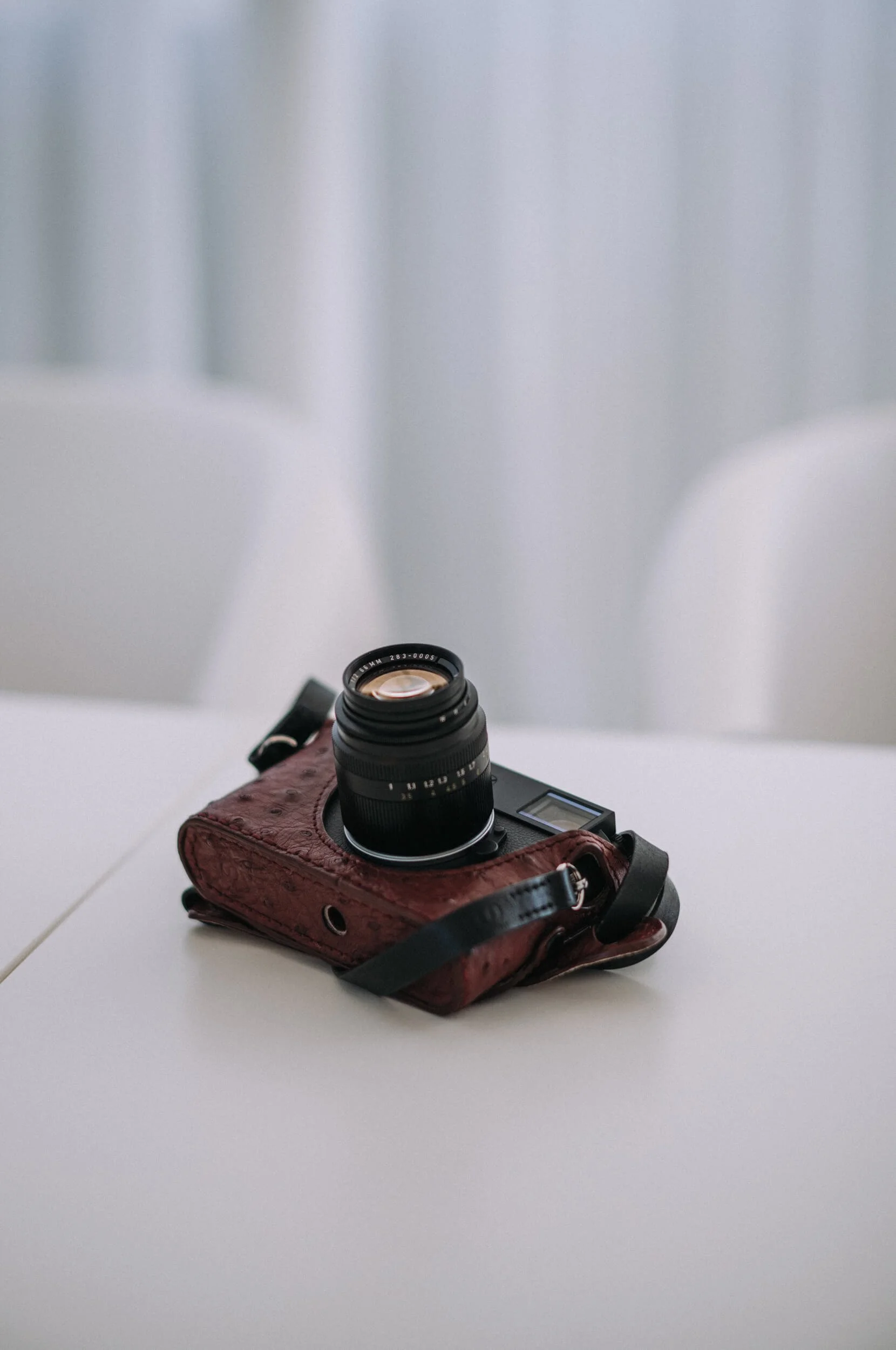
The original ELCAN 66mm f/2 mounted on my Leica M11 Monochrom in the Leitz Café at Leitz Park, Wetzlar. Photographed with the new Leitz Summicron-M 66 f/2, this image brings Walter Mandler's original design and its modern successor together in a single frame. Leather M11 case by Angelo Pelle from Italy.
One of the first questions I asked both Tim Pullmann and Stefan Daniel was surprisingly simple.
Why 66mm?
Unlike Leica's well-established focal lengths: 35mm, 50mm, 75mm or 90mm, the choice of 66mm seems almost random. Yet it wasn't. Every aspect of the original lens was driven by a specific military requirement rather than a photographic one.
Close-up of the original ELCAN 66mm f/2, revealing the front element, vintage coatings and the distinctive ELCAN engraving. Photographed in the Leica Archives during my visit to Wetzlar.
The story begins several decades earlier at Ernst Leitz (Canada) Ltd. (ELC), whose military products carried the ELCAN name.
Established in Midland, Ontario, the Canadian subsidiary initially assembled Leica cameras and lenses using components supplied from Wetzlar. Over time, however, it evolved into something much more ambitious. Under the guidance of Dr. Walter Mandler, ELCAN became an important centre for optical research and development, producing lenses not only for Leica but also for industrial and military applications.
The ELCAN 66mm f/2 was one of those projects.
According to Stefan Daniel, Ernst Leitz (Canada) Ltd. was approached by the United States Navy with a clear brief. Military observers and intelligence personnel required a compact lens capable of resolving an extraordinary amount of detail while remaining as discreet as possible. The equipment had to blend into its surroundings. An observer carrying a large telephoto lens immediately attracted attention. Someone carrying what appeared to be an ordinary Leica rangefinder looked like a tourist.
The negatives could then be enlarged significantly while still revealing critical detail in ships, harbours and military installations.
Walter Mandler later described the 66mm focal length as the optimum compromise for achieving the required resolving power with the optical glass available at the time.
That requirement shaped the entire design.
The lens had to deliver exceptional resolution, perform at its best wide open at f/2, remain compact enough to avoid suspicion and resemble a standard Leica M lens. Those priorities defined every decision Walter Mandler made during its development.
The choice of a 66mm focal length also reflected that balance. While no surviving Leica documentation explains precisely why Walter Mandler settled on 66mm, historical accounts from Leica historian Rolf Fricke record that Mandler himself considered 66mm the optimum compromise for correcting aberrations with the optical glass available at the time while achieving the extraordinary resolving power required by the U.S. Navy. It occupied a space between the familiar 50mm and 90mm lenses, providing additional reach while preserving the discreet proportions the project demanded.
Looking at the original lens today, it is striking how successful that objective was.
Without knowing its history, there is very little to suggest that this understated Leica lens was designed for one of the most unusual roles in the company's history.
The Lens That Was Never Supposed to Survive
Like many aspects of the ELCAN 66mm, its history is surrounded by stories. Some can be verified through archival material, while others have been passed down by former military personnel and Leica collectors. During my conversations with Tim Pullmann and Stefan Daniel, one story stood out in particular, not only because it explains how one of these rare lenses survived, but also how it eventually became part of the Leica Archives.
The ELCAN 66mm was originally supplied as part of a specialised military kit centred around the KE-7A, a modified Leica M4 produced in Midland, Canada, for the U.S. Army. Unlike a standard Leica M4, the KE-7A was adapted for military service with improved sealing, the ability to operate in extreme temperatures and several other modifications intended for demanding field conditions. The complete outfit was regarded as sensitive equipment.
From left to right: the original ELCAN 50mm, the original ELCAN 66mm f/2 and the new Leitz Summicron-M 66 f/2. In front lies Bryan White's handwritten provenance tag, documenting the remarkable survival of the original ELCAN 66mm f/2. Photographed in the Leica Archives during my visit to Wetzlar.
If a single component of the kit was lost, military protocol was strict. Rather than replacing the missing part, the entire outfit had to be destroyed and replaced with a new one. Some of the surviving manuals even describe how the camera and lenses should be rendered unusable if there was a risk of them falling into the wrong hands.
Fortunately, one serviceman chose a different path.
Years later, after leaving the U.S. Navy, Bryan White joined Kodak, where he became a colleague of Kodak Marketing Director Rolf Fricke. Both men shared a deep interest in photography, and their conversations eventually turned to Leica cameras. During one of those discussions, White revealed that he had once been issued a complete KE-7A outfit together with several ELCAN lenses during his military service. Realising the historical significance of what he was hearing, Fricke carefully documented White's story and later attached his handwritten provenance note to the surviving 66mm ELCAN, preserving both its technical background and remarkable journey for future generations.
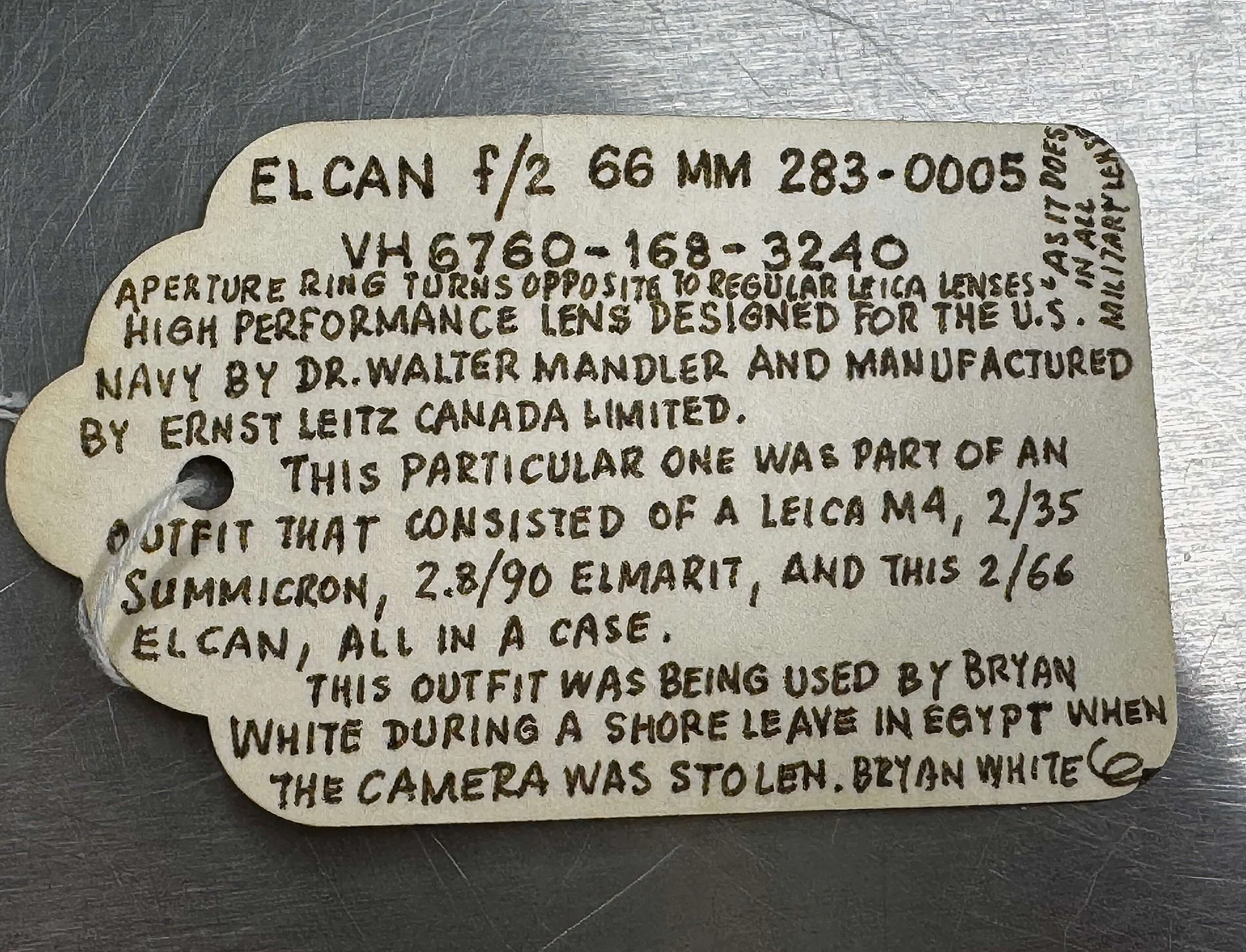
The front of Rolf Fricke's handwritten provenance tag accompanying the original ELCAN 66mm f/2. It records the lens's military origin, technical background and its place within the original KE-7A camera outfit.
White also told Fricke what had happened to the camera outfit. During my visit to the Leica Archives, Tim Pullmann showed me the original handwritten tag that Rolf Fricke had attached to this very lens. On one side, Fricke recorded its technical history, identifying it as an ELCAN 66mm f/2 designed by Dr. Walter Mandler for the U.S. Navy and manufactured by Ernst Leitz Canada. He also noted that this particular lens had originally formed part of a complete military outfit consisting of a Leica M4, a 35mm Summicron, a 90mm Elmarit and the 66mm ELCAN, all supplied together in a dedicated case.
Turning the tag over, the story became even more personal. Fricke had written down Bryan White's own account of what happened after the camera was stolen during shore leave in Egypt. When White reported the theft and asked whether a replacement camera could be issued, he was told that the military paperwork required to replace a single component was so extensive that the remaining outfit was simply ordered to be thrown overboard so an entirely new kit could be issued. According to Fricke's notes, White went below deck and performed what he called a small "throw-away ceremony". Holding the equipment, he said, "Now you are the Navy's," pushed it away, then immediately picked it up again saying, "Now I found you, and now you are mine." Instead of disappearing into the sea, the surviving equipment stayed with him until it eventually found its way to Rolf Fricke.
The reverse side of Rolf Fricke's handwritten provenance tag preserves Bryan White's remarkable account of how the original ELCAN 66mm f/2 escaped military disposal and eventually became part of the Leica Archives.
Today, that collection forms a cornerstone of the Leica Archives in Wetzlar, where the original ELCAN 66mm remains preserved together with Rolf Fricke's handwritten provenance note. Seeing the note still attached to the lens gave the story an entirely different weight. It was no longer simply an anecdote passed between collectors, but a carefully documented history tracing the journey of this very lens from military service into the Leica Archives. Few Leica lenses can be linked so directly to the people who used them and the story of how they survived.
Stefan Daniel smiled as he finished telling the story. Years later, Rolf Fricke even travelled back to the very harbour where the former serviceman had once been expected to dispose of the remaining equipment. Standing there with the rescued Leica, Fricke photographed the same surroundings, quietly bringing the story full circle.
Without Bryan White's decision to ignore military protocol, and without Rolf Fricke's determination to preserve Leica's history, there is a good chance the original ELCAN 66mm would simply no longer exist.
Bringing the ELCAN Back to Life
Stefan Daniel holding the original ELCAN 66mm f/2 alongside the new Leitz Summicron-M 66 f/2 in the Leitz Café at Leitz Park. Photographed with the Leica M11-D and Noctilux-M 75mm f/1.25 ASPH.
During lunch at Leitz Park, my conversation with Stefan Daniel naturally turned to the question I had been wondering about ever since hearing rumours of the project.
Why the ELCAN?
Stefan Daniel holding the original ELCAN 66mm f/2 during our conversation in the Leitz Café at Leitz Park. This portrait was photographed with the new Leitz Summicron-M 66 f/2.
Stefan smiled before explaining that, although I had mentioned the idea to him a few years earlier, the discussion inside Leica had already been underway. Andreas Kaufmann, Chairman of the Supervisory Board, had long been fascinated by the original lens, while Peter Karbe, Head of Optical Development at Leica Camera AG, also saw it as one of the most intriguing designs hidden within the company's history.
The ELCAN represented something different.
Unlike lenses such as the Noctilux 50mm f/1.2 or the Thambar 90mm f/2.2, which already had a place in Leica's photographic heritage, the ELCAN had never been available to photographers. Recreating it meant introducing a forgotten chapter of Leica's history rather than revisiting a familiar classic.
That philosophy eventually became part of Leica's growing Classic line.
One challenge quickly became apparent.
The original archive lens was simply too valuable to dismantle. Taking it apart to measure every element was never considered an option. Instead, Leica's optics team, now led by Dietmar W. Stuible, Head of Optics Development, approached the project in a different way.
The original lens was examined using X-ray imaging and industrial CT scanning. Those scans allowed the engineers to study the internal construction and optical layout without disturbing a single component. From there, measurements could be verified and compared before work began on adapting the design for modern production.
Stefan also revealed that the project benefited enormously from work that had already been carried out by Leitz Cine.
Several years earlier, Leitz Cine had recreated the ELCAN optical design for the HUGO 66mm T2.1 cinema lens. Much of the optical research had therefore already been completed, giving Leica Camera an invaluable starting point. The challenge was no longer to recreate a cinema lens, but to build a fully rangefinder-coupled Leica M lens that remained faithful to Walter Mandler's original concept.
Even with that advantage, the project took around two and a half years.
Listening to Stefan describe the process, it became clear that this was never intended to be a nostalgic exercise. The goal was not to produce a modern interpretation inspired by the ELCAN, but to understand why the original existed in the first place and preserve that character while manufacturing it to contemporary Leica standards.
That philosophy explains several decisions that photographers may initially question today.
The minimum focusing distance remains one metre, just as it did on the original lens. The unusual 66mm focal length was retained. Even details such as the overall proportions and mechanical feel were guided by the historic lens rather than modern expectations.
Leica's technical documentation confirms that the modern lens remains a six-element, five-group design, with a 66mm focal length, a maximum aperture of f/2, a minimum aperture of f/16 and a nine-blade diaphragm. It focuses from 1 metre to infinity and uses the Leica M bayonet with an E49 filter thread.
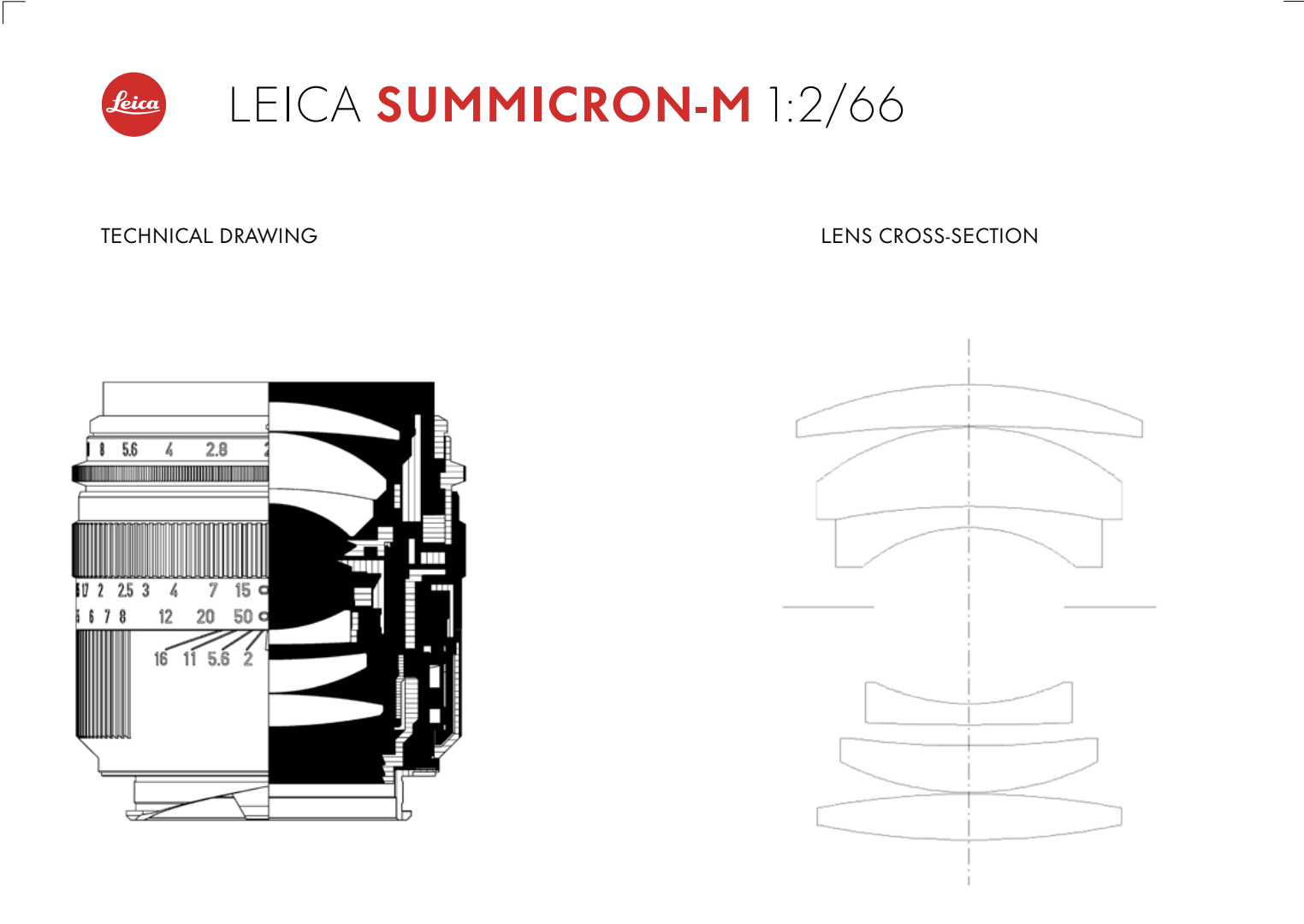
Optical cross-section of the Leica Summicron-M 66 f/2, showing its six-element, five-group optical design.
The result is a lens unlike anything else in Leica's current catalogue.
It is neither a completely modern Leica lens nor a simple reproduction. Instead, it occupies a place somewhere between history and the present, carrying the DNA of Walter Mandler's original design into a camera system that has changed remarkably little since the Cold War.
One interesting question also concerned the name itself. The original lens proudly carried the ELCAN name, reflecting its origins at Ernst Leitz (Canada) Ltd. Before finalising the reissue, Leica contacted Raytheon ELCAN, the Canadian company that today continues to operate under the ELCAN name, to discuss the possibility of using it once again. Leica did not receive a response. As a result, the lens was officially introduced as the Leitz Summicron-M 66 f/2, while the lens itself carries the understated front engraving "LEITZ WETZLAR f/2 66MM". The name ELCAN no longer appears on the lens, but its heritage remains unmistakable, and the optical lineage still leads directly back to Walter Mandler's original Canadian design.
Prototype Leitz Wetzlar 66mm f/2 mounted on my Leica M11-D during my visit to Leitz Park. The pre-production lens shown here carries the simple "LEITZ WETZLAR f/2 66MM" front engraving. Photographed with the Leica M11-D and Noctilux-M 75mm f/1.25 ASPH.
Looking Through Mandler's Lens
Stefan Daniel looking through the original ELCAN 66mm f/2 during our conversation at the Leitz Café in Leitz Park. This portrait was photographed with the new Leitz Summicron-M 66 f/2.
After lunch, Stefan Daniel and I sat down at the Leitz Café. Our conversation moved from Walter Mandler and Leica's optical heritage to the challenges of recreating a lens that had almost disappeared from photographic history.
At one point, Stefan reached for the original ELCAN from the archive and instinctively held it up to his eye. Without saying anything, I picked up the Summicron-M 66 f/2 and made a series of photographs of him. Looking back at the photographs later, I realised they captured the essence of the project better than I ever could have planned. Stefan was looking through the original lens that had survived more than half a century, while I was photographing him with its modern successor.
As our conversation continued, it became clear that Leica had never set out to redesign the ELCAN. The objective was to understand the original lens first. Every decision made by Walter Mandler was questioned, studied and only changed when it was absolutely necessary. That philosophy explains why the unusual 66mm focal length remains, why the minimum focusing distance is still one metre and why the proportions stay very close to the original.
Listening to Stefan describe the development process also changed the way I looked at the lens. Before arriving in Wetzlar, I expected another interpretation of a Leica Classic lens, similar in spirit to the Noctilux 50mm f/1.2 or the Thambar. Instead, I began to understand that this project followed a very different philosophy. The intention was never to create a lens with an obvious vintage signature. It was to preserve the identity of a highly specialised optical design while making it accessible to photographers for the first time.
When I later looked at the original archive lens beside the new version, that approach made perfect sense. The differences between them are subtle. Leica resisted the temptation to modernise the design simply because it could. In doing so, the company has preserved an important piece of its own history rather than reinventing it.
Photographing with the Leica 66mm/f2
Photographing around Leitz Park presents an interesting challenge. It is probably one of the most photographed places in the Leica world, and almost every recognisable corner has already appeared in countless reviews, social media posts and marketing campaigns.
Rather than trying to find locations nobody had photographed before, I approached it differently. The question I kept asking myself was how to use these familiar spaces in a way that still felt personal.
The Casino at Leica Camera AG in Leitz Park, where employees gather for lunch and coffee. Photographed with the Leitz Summicron-M 66 f/2 during my first afternoon with the lens.
For most of the afternoon I worked with two cameras, the Leica M11-D and the Leica M11 Monochrom. Switching between colour and black and white allowed me to see the lens in two very different ways. The M11-D revealed its colour palette and contrast, while the Monochrom placed all the emphasis on light, form and tonal transitions.
The architecture around Leitz Park naturally became part of the compositions. The concrete pillars surrounding the Leitz Cine building created simple geometric frames, while the restrained Bauhaus architecture offered clean backgrounds that never distracted from the subject. At the same time, I tried to avoid compositions that felt overly restrained. Whenever possible I looked for a touch of colour, an interesting reflection or a small detail that added a little warmth to the frame.
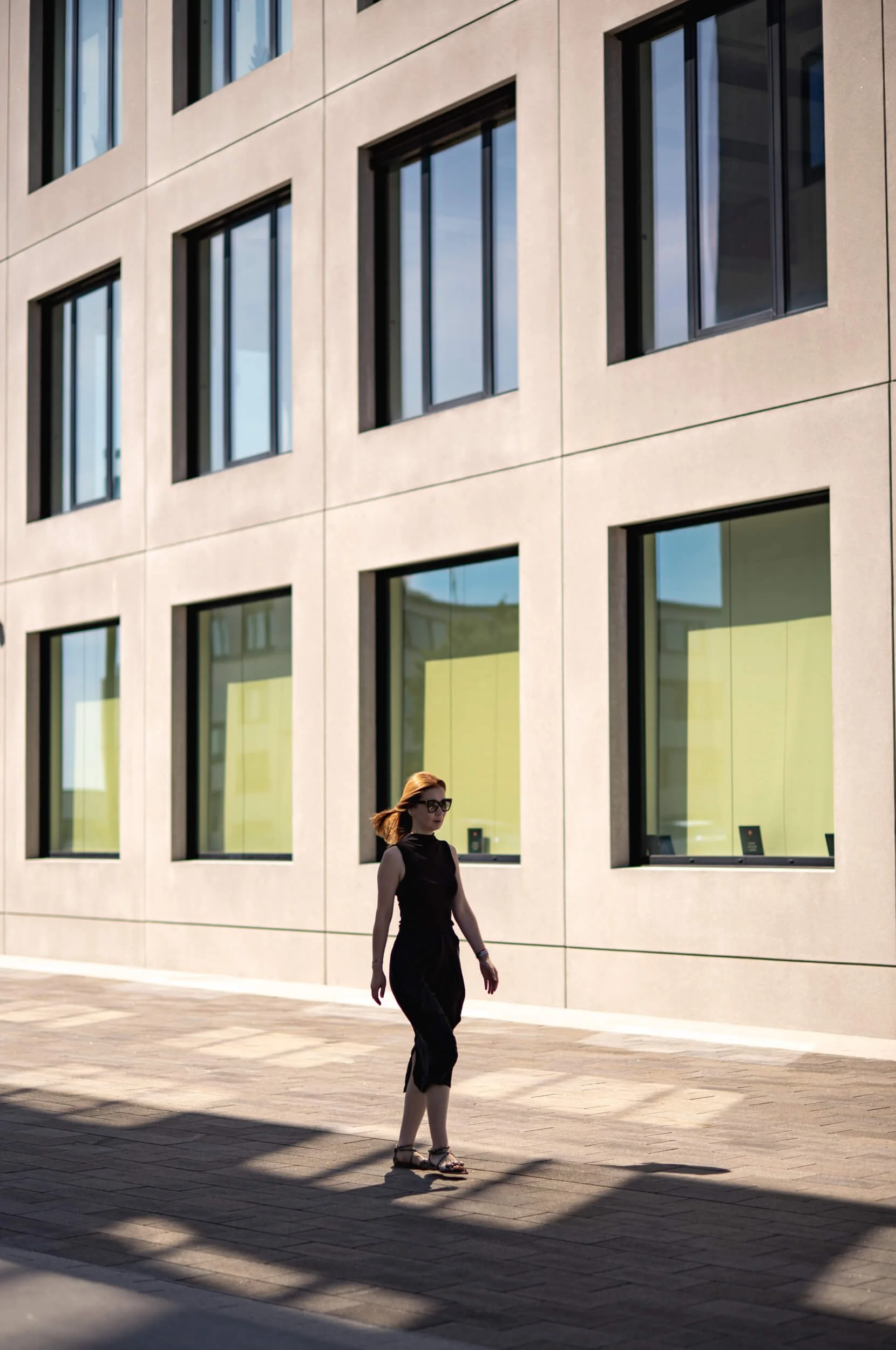
Aliya photographed at Leitz Park, where the clean lines and geometric architecture became a natural part of the composition. Photographed with the Leitz Summicron-M 66 f/2.
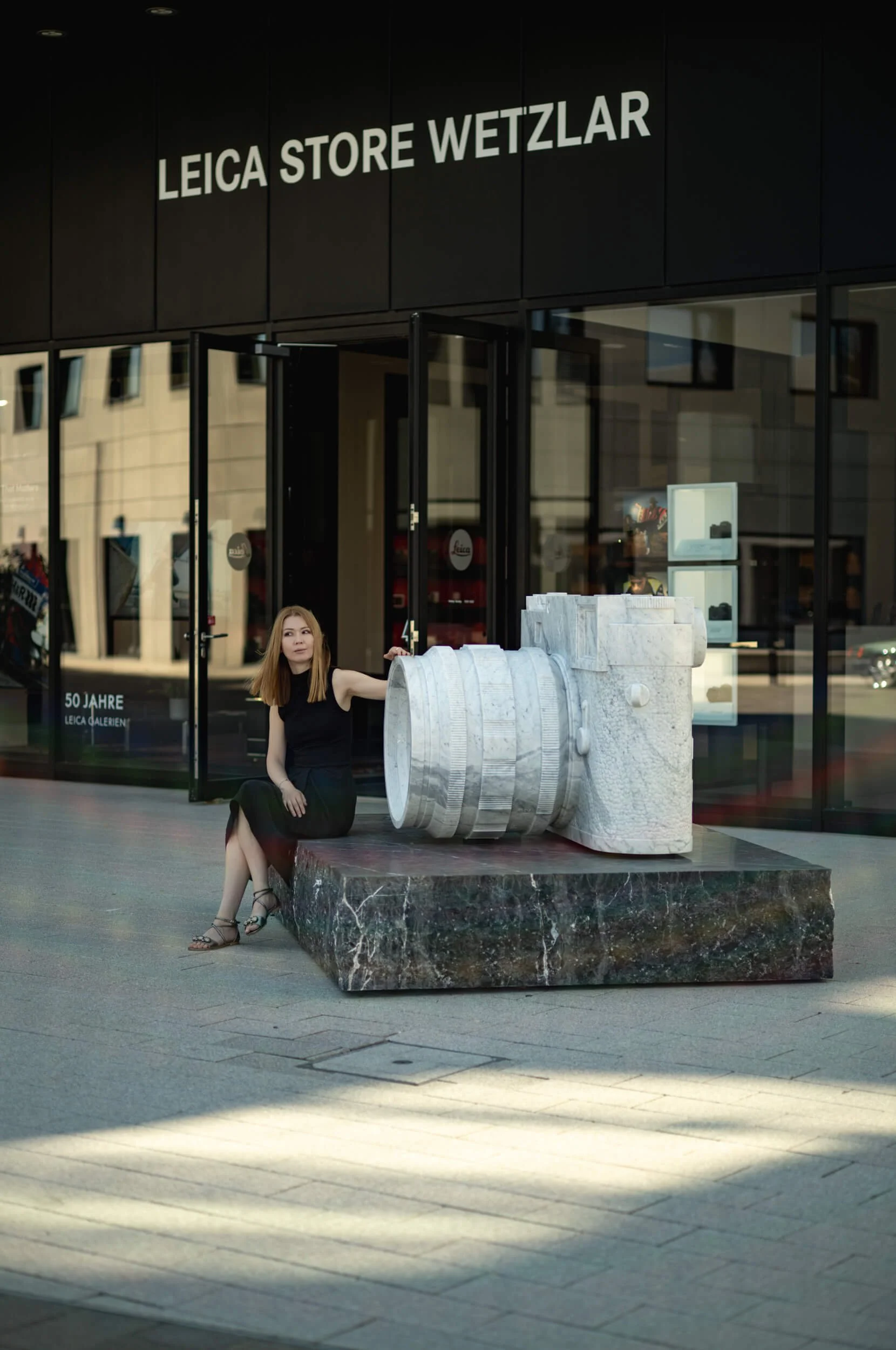
Aliya beside the Carrara marble Leica sculpture outside Leica Store Wetzlar. Created by Dutch artist Casper Braat, the sculpture has become one of the defining landmarks of Leitz Park. Photographed with the Leitz Summicron-M 66 f/2.
One stop I couldn't ignore was the large Carrara marble Leica sculpture outside the Ernst Leitz Museum. Created by Dutch artist Casper Braat, it has become one of the defining landmarks of Leitz Park. Having followed the project from the beginning through Leica Store Lisse, it felt appropriate to include it in the series.
From there we moved into the museum, where an exhibition by Donata and Wim Wenders provided an unexpected source of inspiration. Rather than simply placing Aliya in front of the photographs, we started interacting with the space itself.
One image in particular was entirely Aliya's idea.
A large photograph showed a young child leaning over a wall with an outstretched hand. Aliya suggested sitting on the floor beneath it and reaching upwards, creating the illusion that the two figures were trying to touch. It is one of those photographs that wasn't planned before entering the exhibition. It simply happened because we allowed ourselves to respond to the surroundings instead of forcing an idea.
That approach proved to suit the Summicron-M 66 f/2 particularly well.
The 66mm focal length encouraged me to simplify each composition. It offered enough compression to isolate Aliya from the background while still allowing the architecture and artwork to remain an important part of the image. Instead of relying on dramatic perspective, I found myself paying closer attention to lines, balance and the relationship between foreground and background.
By the end of the afternoon I realised I had stopped thinking about the lens as a rare collector's item. It had simply become another Leica M lens that encouraged me to slow down, observe and make photographs.
Aliya interacting with an artwork from the Donata and Wim Wenders exhibition at the Ernst Leitz Museum. The image was inspired by the exhibition itself and photographed with the Leitz Summicron-M 66 f/2.
Rendering of the Leitz Summicron-M 66 f/2
Portrait of Aliya photographed at Leitz Park with the Leitz Summicron-M 66 f/2. The image demonstrates the lens's gentle transition from focus to out-of-focus areas, natural compression and refined rendering at f/2.
The rendering of the Summicron-M 66 f/2 was probably the biggest surprise of the entire review.
Having spent time with the original archive lens, I expected Leica to recreate not only its optical formula but also more of its vintage characteristics. Instead, the Summicron-M 66 f/2 feels surprisingly refined while remaining respectful of Walter Mandler's original design.
Wide open at f/2, the lens is already impressively sharp. Fine detail is resolved with confidence, but sharpness never dominates the image. What caught my attention far more was the way the lens renders depth.
There is a gentle fall-off from the plane of focus into the background. Instead of an abrupt transition, subjects gradually separate from their surroundings in a way that occasionally reminded me of medium format portrait lenses. Not because the depth of field is dramatically shallower, but because of the combination of the 66mm focal length, the subtle compression and the smooth transition from in-focus to out-of-focus areas.
Photographers expecting the rendering of a traditional 50mm Summicron may be surprised. Although the Summicron-M 66 f/2 shares the same maximum aperture, it follows a very different optical philosophy. Having photographed extensively with every generation of the 50mm Summicron, with the exception of the APO version, I found the Summicron-M 66 f/2 noticeably sharper at full aperture. The additional focal length also introduces more compression, resulting in stronger subject separation without relying on an extremely shallow depth of field. It isn't simply a 50mm Summicron with an extra 16mm of focal length. It has its own identity.
The colour rendering is equally modern. Compared to the original ELCAN 66mm f/2, the Summicron-M 66 f/2 produces richer colours and slightly stronger contrast, most likely thanks to its modern coatings. The original lens has a quieter palette with softer contrast, something that naturally fits my own preference for more muted colours. I also noticed that the white balance tended to lean slightly towards the cooler side. Shooting with Auto White Balance on the Leica M11-D, even on a warm summer afternoon in Wetzlar, the files often retained a subtle coolness.
The rendering is smooth and well balanced. Images are crisp from full aperture, without haze or distracting halos, while chromatic aberrations are very well controlled. I occasionally noticed a small amount of purple fringing in high-contrast situations, but it remained minor and never distracted from the image. It is impressive how well corrected this design remains considering its age. Simpler backgrounds dissolve beautifully, while more complex textures, such as foliage, retain a little more structure. I also noticed a subtle cat's-eye effect towards the outer edges of the frame when photographing wide open. The blur discs themselves remain clean, with no obvious onion-ring structures or distracting bright edges.
Trying to compare the Summicron-M 66 f/2 with another Leica lens is surprisingly difficult. It doesn't possess the romantic character of the 75mm Summilux-M, one of Walter Mandler's best-known Leica lenses, yet it also isn't trying to match the extraordinary correction of Leica's APO lenses. If anything, it occupies a space somewhere between Leica's classic and contemporary optics. It combines a modern level of correction with a rendering that never feels overly analytical, making it one of the more distinctive lenses currently available in the M system.
What the MTF curves show
Leica's published MTF curves for the Summicron-M 66 f/2 at f/2, f/2.8 and f/5.6.
Leica's published MTF curves provide an interesting technical counterpart to what I found in practice: the Summicron-M 66 f/2 is already highly capable at full aperture, with Leica publishing measurements at f/2, f/2.8 and f/5.6 for both contrast and resolution across the image field.
The official brochure confirms that the curves are measured at infinity at f/2, f/2.8 and f/5.6, with 5, 10, 20 and 40 lp/mm measurements.
Late afternoon light and geometric architecture at Leitz Park, Wetzlar. Photographed with the Leitz Summicron-M 66 f/2.
Who is this lens really for?
That is perhaps the most difficult question to answer.
If you are looking for a Leica Classic lens with an obvious vintage signature, like the Thambar or the Noctilux 50mm f/1.2, this probably isn't the lens for you. Personally, my own photography naturally gravitates towards that softer, more romantic rendering.
Close-up portrait of Aliya photographed with the Leica M11 Monochrom and Leitz Summicron-M 66 f/2. The image highlights the lens's smooth bokeh, natural tonal transitions and excellent sharpness at full aperture.
Interior of the Leitz Hotel restaurant photographed wide open at f/2 with the Leica M11 Monochrom and Leitz Summicron-M 66 f/2. The image demonstrates the lens's clean rendering, smooth background blur and restrained character in a challenging indoor scene.
The Leitz Summicron-M 66 f/2 appeals to a different kind of photographer. It is for someone who appreciates Leica's history, values Walter Mandler's optical legacy and enjoys owning something genuinely unusual. The 66mm focal length alone makes it stand apart from anything else in the Leica M system. It offers a little more compression and subject separation than a traditional 50mm, while remaining considerably smaller and more discreet than lenses such as the Noctilux-M 75mm f/1.25 ASPH.
If you are looking for a compact lens that delivers excellent sharpness with just a subtle touch of classic Leica character, this is a very compelling combination. It is small, unobtrusive and highly capable, exactly the qualities the U.S. Navy originally asked Walter Mandler to achieve more than fifty years ago.
Its limited production will undoubtedly make it attractive to collectors as well. I would not be surprised if demand quickly exceeds supply. If this lens speaks to you, I wouldn't wait too long before contacting your Leica Store and putting your name on the reservation list.
The ELCAN tells a chapter of Leica's history that would otherwise remain hidden in archives and collector cabinets. It introduces photographers to one of Walter Mandler's least familiar designs and demonstrates just how advanced his optical thinking already was during the Cold War.
That alone makes the ELCAN 66mm f/2 one of the most fascinating Leica lenses I have ever had the opportunity to photograph with.
Final Thoughts
Before travelling to Wetzlar, I probably had a different idea of what the Summicron-M 66 f/2 would be. Instead, I found a lens that feels considerably more modern than its history might suggest.
Because it now sits within Leica's Classic line, I expected a lens with a more obvious vintage signature, something closer to the character of the Thambar, the Noctilux 50mm f/1.2 or the Summilux-M 50mm pre-ASPH. Instead, I found a lens that feels considerably more modern than its history might suggest.
At first, it wasn't quite what I had expected.
Sunset at Leitz Park after a day photographing with the Leitz Summicron-M 66 f/2. The quiet evening became a fitting conclusion to a lens that revealed far more than I had expected.
Portrait made with the original ELCAN 66mm f/2 at the Leitz Museum, using a glass door as a reflection. I warmed the white balance slightly to complement the cooler rendering of the original lens.
The rendering wasn't quite what I had imagined, simply because it didn't align with my own preference for softer, lower-contrast lenses with a stronger vintage signature. As I spent more time with the Summicron-M 66 f/2, however, I realised that my expectations had been shaped by Leica's previous Classic releases rather than by the original purpose of this lens.
Walter Mandler's original ELCAN was never designed to be romantic. It was designed to resolve detail, perform at full aperture and remain discreet. Looking at it through that lens, the modern rendering suddenly makes perfect sense. In fact, it becomes difficult not to admire what Dr. Walter Mandler achieved more than half a century ago. Even today, the optical formula feels impressively capable, requiring surprisingly few compromises to meet contemporary expectations.
That, perhaps, is what impressed me most.
Rather than redesigning Walter Mandler's original ELCAN, Leica chose to respect its original identity. The result is a lens that sits comfortably between two worlds. It carries subtle traces of its heritage, yet performs much closer to a modern Leica lens than I had anticipated.
Will it become my personal favourite in the Leica Classic line?
Probably not, simply because my own work naturally gravitates towards lenses with a more pronounced vintage character.
Do I understand why Leica brought it back?
Absolutely.
The Leica 66/f2 opens a chapter of Leica's history that would otherwise remain hidden in archives and collector cabinets. Through it, photographers are introduced to one of Walter Mandler's least familiar designs, demonstrating just how advanced his optical thinking already was during the Cold War.
That alone makes the ELCAN 66mm f/2 one of the most fascinating Leica lenses I have ever had the opportunity to photograph with.
Leica Summicron-M 66 f/2 — Technical Specifications
Stefan Daniel examining the new Leitz Summicron-M 66 f/2 during our discussion about its development in the Leitz Café at Leitz Park. Photographed with the Leitz Summicron-M 66 f/2.
Focal length
Maximum aperture
Minimum aperture
Optical construction
Focus range
Minimum object field
Maximum reproduction scale
Angle of view
Diaphragm
Mount
Filter thread
Lens hood
Length
Diameter
Weight
Order number
66mm
f/2
f/16
6 elements in 5 groups
1m to infinity
321 × 481mm
1:13.4
36.3° diagonal / 30.5° horizontal / 20.6° vertical
9 blades
Leica M bayonet
E49
Screw-on
approx. 60.1mm
approx. 60mm
approx. 456g
11099
About the Images
Coffee at the Leitz Café in Leitz Park. Photographed with the original ELCAN 66mm f/2 mounted on the Leica M11 Monochrom.
Unless stated otherwise, the photographs in this review were made during my visit to Leitz Park in Wetzlar using both the original Elcan 66mm f/2 and the new Summicrom-M 66/f2.
There was one unexpected twist during my stay. Both my Leica M11 Monochrom and Leica M11-D were with Leica Customer Care for some routine adjustments. As a result, several of the behind-the-scenes photographs made inside the Leica Archive were captured on my iPhone 15 Pro.
Fortunately, Leica Customer Care completed the work so efficiently that both cameras were ready again in time for lunch with Stefan Daniel and my portrait session around Leitz Park later that afternoon.
My thanks to Nico and Michel for making that possible.
The portrait photographs throughout this review were made using the Leica M11 Monochrom and Leica M11-D paired with the original ELCAN 66mm f/2 and the Leitz Summicron-M 66 f/2. Unless otherwise noted, the product photographs were captured with the Leica M11-D and the Noctilux-M 75mm f/1.25 ASPH.
Acknowledgements
My sincere thanks to everyone at Leica Camera AG who helped make this project possible.
Leica Camera AG headquarters at Leitz Park, photographed with the Leitz Summicron-M 66 f/2.
Special thanks to Murat Akkas for organising my visit to Wetzlar, Tim Pullmann for sharing his knowledge of the Leica Archives and the renowned Rolf Fricke Collection, Stefan Daniel for the many inspiring conversations about Walter Mandler, the history of the ELCAN and Leica's decision to bring this extraordinary lens back into production, and Peter Karbe for sharing additional insight into the optical development of the Leitz Summicron-M 66 f/2.
I would also like to acknowledge Leica historian Rolf Fricke, whose meticulous research and preservation of the original ELCAN's history provided an invaluable historical foundation for this article.
A special thank you as well to David Stephens from Leica Store Manchester for sharing his passion, historical knowledge and generous hospitality. He is a true gem of the Leica world.
A special thank you as well to Marcela Verschoor for being willing to model and for sharing her passion for monochrome Leica photography.
Finally, thank you to Aliya for her creativity, patience and for constantly seeing photographs where I initially only saw locations. Many of my favourite images from this project began with her ideas.
Additional Images



About Milan Swolfs
Milan Swolfs is a fine art portrait photographer from Antwerp, Belgium, renowned for his distinctive blend of burlesque and vintage aesthetics. His work channels the timeless Hollywood glamour of the 1920s and 1930s, capturing both men and women in bold yet elegantly refined portraits.
Beginning his career photographing Europe’s largest burlesque events, Milan later transitioned into fine art photography. As an ambassador for Leica Camera and Harlowe Creators, his work has been featured in LFI (Leica Fotografie International), Medium Format Magazine, and Viewfinder. In 2022, he debuted his solo exhibition, Light of Seduction, at the Leica Store in Porto. Most recently, from late 2024 to early 2025, his latest exhibition, Echoes of Elegance: A Timeless Journey, was showcased at the Leica Store Beaumarchais in Paris.
Milan’s portraits celebrate individuality and classic beauty, reviving the charm and allure of a bygone era.
